
A yacht charter in Croatia costs roughly €1,000–€6,000 a week for a bareboat sailing yacht and €3,000–€9,500 for a catamaran, depending on size and season. The season runs from May to October, and June and September are the best months for most crews. Central Dalmatia, starting from Split, is the most popular area; the Šibenik and Kornati archipelagos suit quieter weeks, and Dubrovnik is the gateway to the southern islands.
With more than a thousand islands, short distances and plenty of harbours, Croatia is one of the easiest places in the Mediterranean to charter a yacht. This guide covers the sailing regions, prices, winds and rules to plan a yacht charter in Croatia in 2027. To compare it with our other destinations side by side, see our yacht charter destinations guide.
| Typical week (bareboat) | €1,000–€6,000 sailing yacht; €3,000–€9,500 catamaran |
| Season | May to October |
| Best months | June and September |
| Main winds | Maestral (afternoon north-westerly), bora (gusty north-easterly), jugo (south-easterly) |
| Licence (bareboat) | A recognised skipper licence such as the ICC, plus a VHF radio certificate (SRC) on board |
| Main charter bases | Split, Trogir, Šibenik, Zadar, Dubrovnik, Pula |
| Changeover | Usually Saturday |
| Local extras | Tourist tax per person, national park tickets, moorings |
| When to book | 6–9 months ahead for July and August |
Where to sail in Croatia: the main sailing regions
Croatia’s coast runs from Istria in the north to Dubrovnik in the south, with most charter bases between Zadar and Split. Each region has its own character, from the busy islands of Central Dalmatia to the bare, protected Kornati.
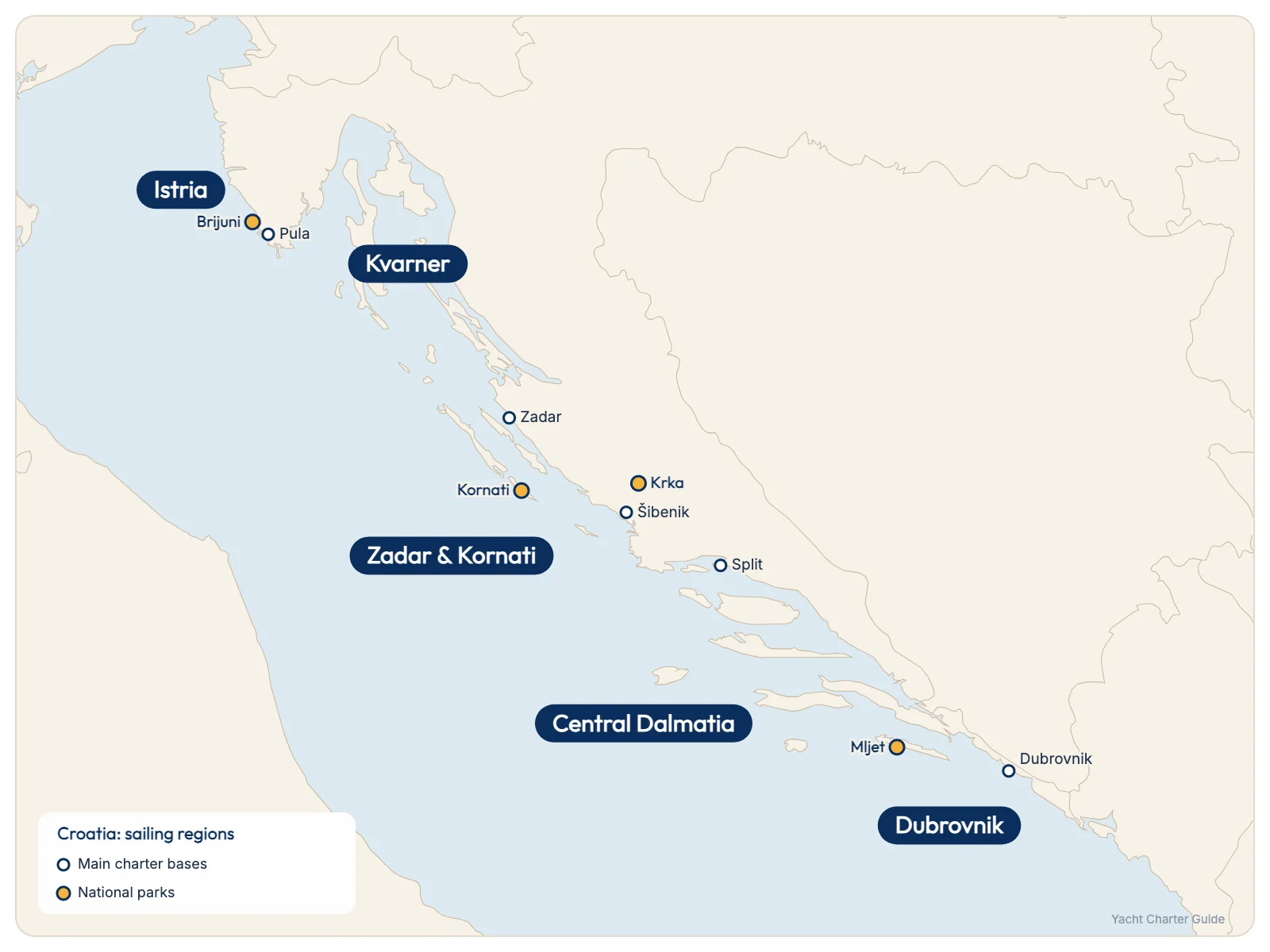
| Character | Level | Main bases | Best for | |
|---|---|---|---|---|
| Central Dalmatia | Hvar, Brač, Šolta and Vis; busy, lively harbours | Beginner to intermediate | Split, Trogir, Kaštela | A first week, island hopping, nightlife on Hvar |
| Šibenik archipelago | Short legs, island villages and the Krka river | Beginner to intermediate | Šibenik, Skradin, Primošten | Families, mixed-experience crews |
| Zadar and Kornati | Bare islands, protected waters, quiet bays | Intermediate | Zadar, Sukošan, Biograd, Murter | Nature, quieter anchorages |
| Dubrovnik and the south | Elaphiti Islands, Mljet, Korčula, Lastovo | Beginner to advanced | Dubrovnik, Slano | Historic towns, longer southern passages |
| Kvarner | Krk, Cres and Lošinj; more exposed to the bora | Intermediate to advanced | Krk, Punat, Mali Lošinj | Experienced crews, fewer boats |
| Istria | Historic coastal towns and the Brijuni islands | Intermediate | Pula, Rovinj | Short trips, culture |
Croatia’s highlights by yacht
Hvar, Brač and Vis
The classic Central Dalmatia loop: Hvar town and the Pakleni islands, Bol on Brač, and remote Vis with the Blue Cave on Biševo.
Kornati and Telašćica
A national park and a nature park of bare islands and sheltered coves, best explored from Murter, Biograd or Zadar.
Dubrovnik, Mljet and Korčula
The Elaphiti Islands, Mljet National Park and the old town of Korčula, south of Split.
How much does a yacht charter in Croatia cost in 2027?
These are typical weekly charter fees before extras. Bases in the north, such as Zadar and Šibenik, are often 15–30% cheaper than Split and Dubrovnik.
| Low season (April–May, September–October) | High season (June–August) | |
|---|---|---|
| Sailing yacht, 30–60 ft | €1,000–€2,500 | €2,800–€6,000 |
| Catamaran, 40 ft and over | €3,000–€4,500 | €5,000–€9,500 |
| Motor yacht | €2,500–€5,000 | €5,500–€12,000+ |
- Security deposit: €1,000–€5,000 depending on the boat, often replaceable with a damage waiver.
- Tourist tax: charged per person per day, around €1.33 on recent figures.
- Moorings: €25–€100+ a night in marinas; cheaper on town quays and buoys.
- Fuel: roughly €100–€500 a week depending on the boat and how much you motor.
- National parks: entry tickets for boats in parks such as Kornati and Mljet, priced by boat size and season.
- Skipper: about €150–€200 a day if nobody holds a licence.
Bareboat, skippered or crewed?
| What you get | Licence needed | Extra cost | |
|---|---|---|---|
| Bareboat | The boat only; you sail it yourself | Skipper licence plus a VHF certificate on board | None |
| Skippered | A professional skipper | No | About €150–€200 a day plus food |
| Crewed | Skipper plus hostess or cook, often on catamarans or gulets | No | Crew fee plus provisioning |
Croatia is also one of the best places in the Mediterranean for a gulet cruise: traditional wooden motor-sailers with a full crew, usually booked by the cabin or for the whole boat.
Best time to charter a yacht in Croatia
| Sea (approx.) | Wind | Crowds | Price | |
|---|---|---|---|---|
| May | 18–20°C | Light to moderate | Low | Low |
| June | 21–23°C | Moderate maestral | Moderate | Mid |
| July | 24–25°C | Afternoon maestral | High | High |
| August | 24–25°C | Afternoon maestral | Peak | High |
| September | 22–24°C | Moderate, more variable | Moderate | Mid |
| October | 19–21°C | Variable, more bora and jugo | Low | Low |
June and September offer the best balance: warm water, steady afternoon breezes, fewer boats and lower prices than in July and August. The bora can blow hard at any time of year, especially near the mainland; always check the forecast before a crossing.
Sample 7-day sailing itinerary from Split
- Day 1: Split to Šolta. A short first leg to Maslinica or Nečujam.
- Day 2: Šolta to Vis. The longest crossing of the week, to Vis town or Komiža.
- Day 3: around Vis. The Blue Cave on Biševo in the morning, a quiet bay in the afternoon.
- Day 4: Vis to Hvar. Anchor in the Pakleni islands and take the water taxi to Hvar town.
- Day 5: Hvar to Stari Grad or Vrboska. Quieter harbours on Hvar’s north coast.
- Day 6: Hvar to Brač. Bol and the Zlatni Rat beach, or Milna for the night.
- Day 7: Brač to Split. Back to base by Friday evening.
Practical information
- Licence: the skipper needs a recognised licence (ICC, RYA Day Skipper and above, or a national equivalent), and someone on board must hold a VHF radio certificate. Bring the originals.
- Changeover: check-in usually on Saturday afternoon, return to the base on Friday evening.
- Where to start: Split or Trogir for Central Dalmatia, Šibenik or Zadar for the Kornati, Dubrovnik for the south.
- Mooring: marinas, town quays with lazy lines, and many restaurant buoys in popular bays.
Frequently asked questions
How much does it cost to charter a yacht in Croatia?
A bareboat sailing yacht costs roughly €1,000–€6,000 a week depending on size and season, and a catamaran €3,000–€9,500. Add the tourist tax, moorings, fuel, national park tickets and a deposit or damage waiver.
Do you need a licence to charter a yacht in Croatia?
For a bareboat charter, yes: the skipper needs a recognised licence such as the ICC, and someone on board must hold a VHF radio certificate. Skippered and crewed charters need no licence.
When is the best time to sail in Croatia?
June and September are the best months for most crews: warm water, steady breezes and fewer boats than in July and August. The season runs from May to October.
Where is the best place to start a yacht charter in Croatia?
Split or Trogir for a first week in Central Dalmatia, with Hvar, Brač and Vis within easy reach. Zadar and Šibenik are often cheaper and closer to the Kornati.
Is Croatia cheaper than Greece for a yacht charter?
Prices are broadly comparable for similar boats. Croatia can be cheaper from its northern bases such as Zadar and Šibenik, while Greece is cheapest in the Ionian. See our yacht charter in Greece guide to compare.
Do you pay to sail in Croatian national parks?
Yes. Parks such as Kornati and Mljet charge an entry ticket for boats, priced by boat size and season. Buying it in advance is often cheaper than paying on the water.