BVI Sailing Itinerary: 7 Days from Tortola (2027 Guide)
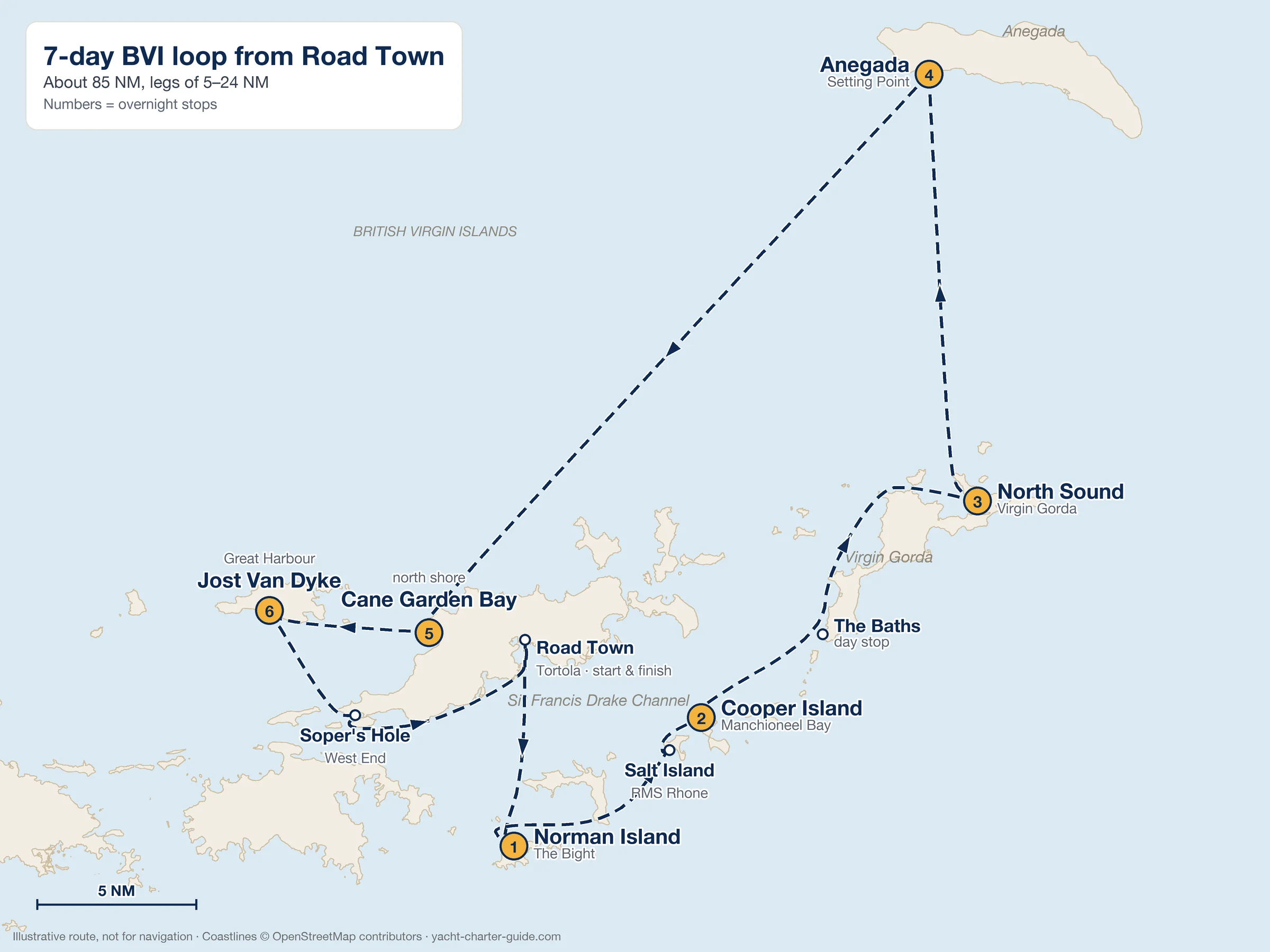
The classic one-week BVI sailing itinerary is a loop from Road Town on Tortola: Norman Island, the wreck of the RMS Rhone, Cooper Island, The Baths on Virgin Gorda, North Sound, Anegada, Cane Garden Bay and Jost Van Dyke. Our version covers about 85 nautical miles in legs of 5 to 24 NM, measured at sea on OpenStreetMap coastlines, and most overnight stops are sheltered bays with mooring balls. Most legs are short. Only the run back from Anegada is a longer open-water passage, and you can skip it.
Two rules shape the whole week. First, National Park mooring balls are for day use only, so you need a private mooring, a marina or an anchorage every night. Second, night sailing is not permitted on charter boats: you must be moored at least one hour before sunset (The Moorings, BVI travel information, retrieved 3 November 2026). For prices, seasons and the other Caribbean charter areas, start with our Caribbean yacht charter guide.
Key takeaways
- A 7-day loop from Road Town covers about 85 NM in legs of 5 to 24 NM: Norman Island, Salt Island, Cooper Island, The Baths, North Sound, Anegada, Cane Garden Bay and Jost Van Dyke.
- National Park moorings, such as those at The Baths and the RMS Rhone, are for day use only; pick up a private mooring ball or anchor for the night.
- Night sailing is not allowed on charter yachts: be on your mooring at least one hour before sunset.
- A cruising permit costs US$4 per person per day on a BVI-based charter boat (US$16 on a foreign-based one); The Moorings adds it to your invoice.
- Anegada is optional: it is a low coral island ringed by an 18-mile reef, and some charter companies limit their support there.
What does the 7-day BVI route look like?
The loop starts and ends at Wickhams Cay in Road Town, where The Moorings and Sunsail have their bases. It works east, upwind, along the Sir Francis Drake Channel while the legs are short. It then turns north at Virgin Gorda for North Sound and Anegada, and comes back west, downwind, along the north shore of Tortola to Jost Van Dyke. Distances are our own measurements along a sea route that keeps clear of the coast, so expect your log to read a little more once you tack.
| Day | Leg | Distance | Night |
|---|---|---|---|
| 1 | Road Town to Norman Island | about 7 NM | The Bight, Norman Island |
| 2 | Norman Island to Salt Island (RMS Rhone) and Cooper Island | about 10 NM | Manchioneel Bay, Cooper Island |
| 3 | Cooper Island to The Baths and North Sound | about 13 NM | North Sound, Virgin Gorda |
| 4 | North Sound to Anegada | about 14 NM | Setting Point, Anegada |
| 5 | Anegada to Cane Garden Bay | about 24 NM | Cane Garden Bay, Tortola |
| 6 | Cane Garden Bay to Jost Van Dyke | about 5 NM | Great Harbour, Jost Van Dyke |
| 7 | Jost Van Dyke to Road Town via Soper’s Hole | about 12 NM | Road Town (return) |
The week adds up to about 85 NM. That leaves most of each day for snorkelling, beach stops and lunch at anchor, which is what most crews come to the BVI for.
Day-by-day BVI sailing itinerary
Day 1: Road Town to Norman Island
Boarding times depend on the company: The Moorings boards at noon, Sunsail at 6 pm (Sunsail, BVI useful information, retrieved 3 November 2026). With a noon start you have time for the short hop across the Sir Francis Drake Channel to The Bight on Norman Island, a large bay with a mooring field and room to anchor outside it. With an evening start, spend the first night at the base and leave early the next morning.
Day 2: Norman Island, the RMS Rhone and Cooper Island
Snorkel the Caves on the west side of The Bight and The Indians just north of Norman Island in the morning, then sail east to Salt Island. The RMS Rhone sank there in a hurricane on 29 October 1867, when she was thrown onto Black Rock Point. The wreck lies in up to 26 m (85 ft) of water, and the area has been a national park since 1980 (Wikipedia, RMS Rhone). Use the park’s day moorings for the dive or snorkel, then move on for the night to Manchioneel Bay on Cooper Island, a short sail to the east.
Day 3: Cooper Island, The Baths and North Sound
Leave Cooper early: The Baths on Virgin Gorda are one of the busiest stops in the islands, and the day moorings fill up fast. Tie the dinghy to the dinghy line, swim ashore and pay the park fee: a one-day pass costs US$3 and also covers Devil’s Bay, Stoney Bay and Spring Bay (National Parks Trust, The Baths ticket, retrieved 3 November 2026). Your charter’s National Parks permit does not include this entry (The Moorings).
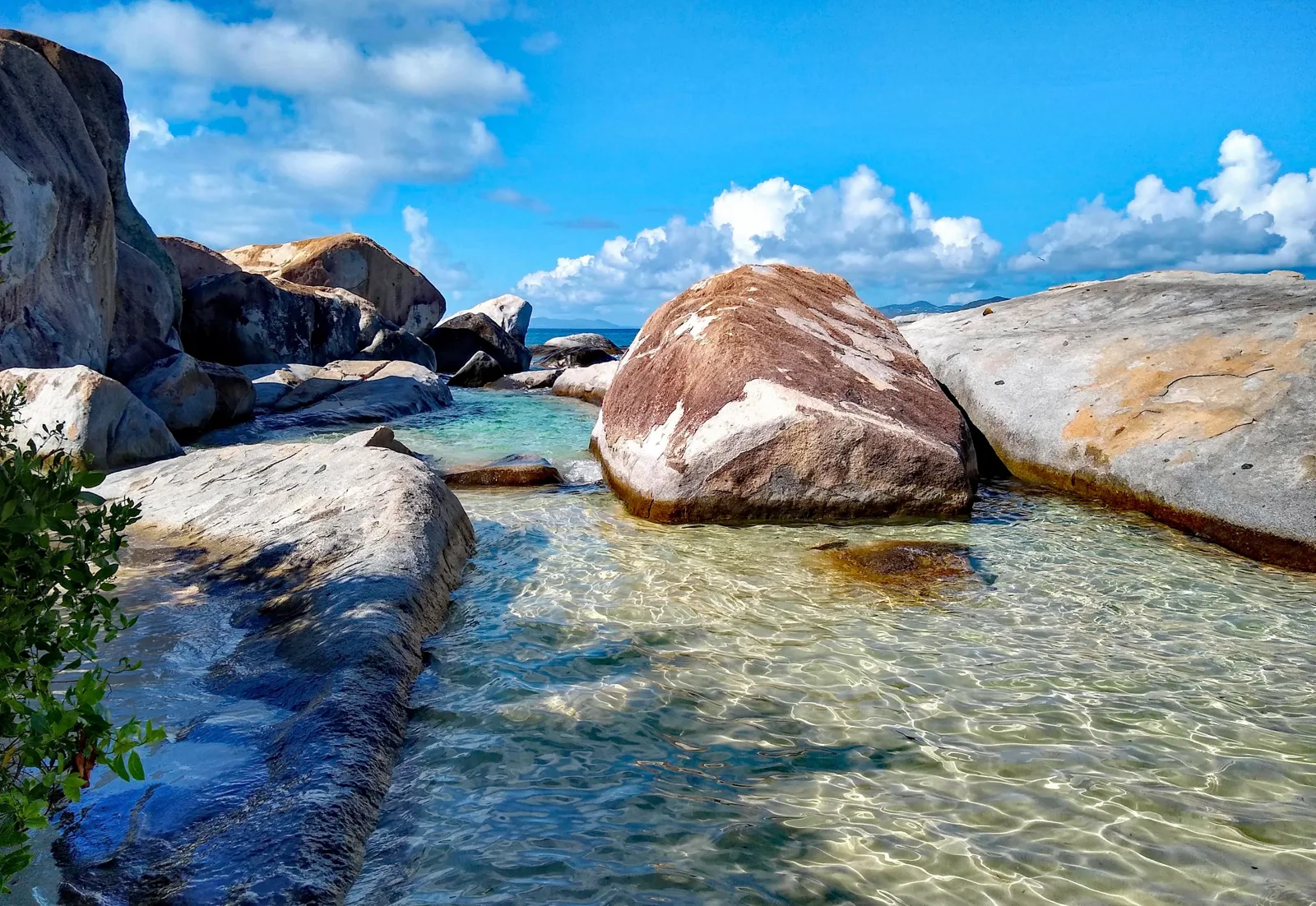
In the afternoon sail north along the west coast of Virgin Gorda and enter North Sound, a large sheltered lagoon with mooring fields, resorts and water sports. It is the best-protected night of the week.
Day 4: North Sound to Anegada
Anegada is different from the rest of the BVI. It is a flat island of coral and limestone, and its highest point is only about 8.5 m above the sea. It lies about 15 statute miles north of Virgin Gorda. Horseshoe Reef, an 18-mile barrier reef around it, has caused hundreds of shipwrecks (Wikipedia, Anegada). Sail in good light with the sun high behind you, follow the marked channel into Setting Point, and keep a crew member on the bow to watch for coral heads. Ask your charter company before you go: Sunsail, for example, does not offer chase-boat coverage at Anegada (Sunsail).
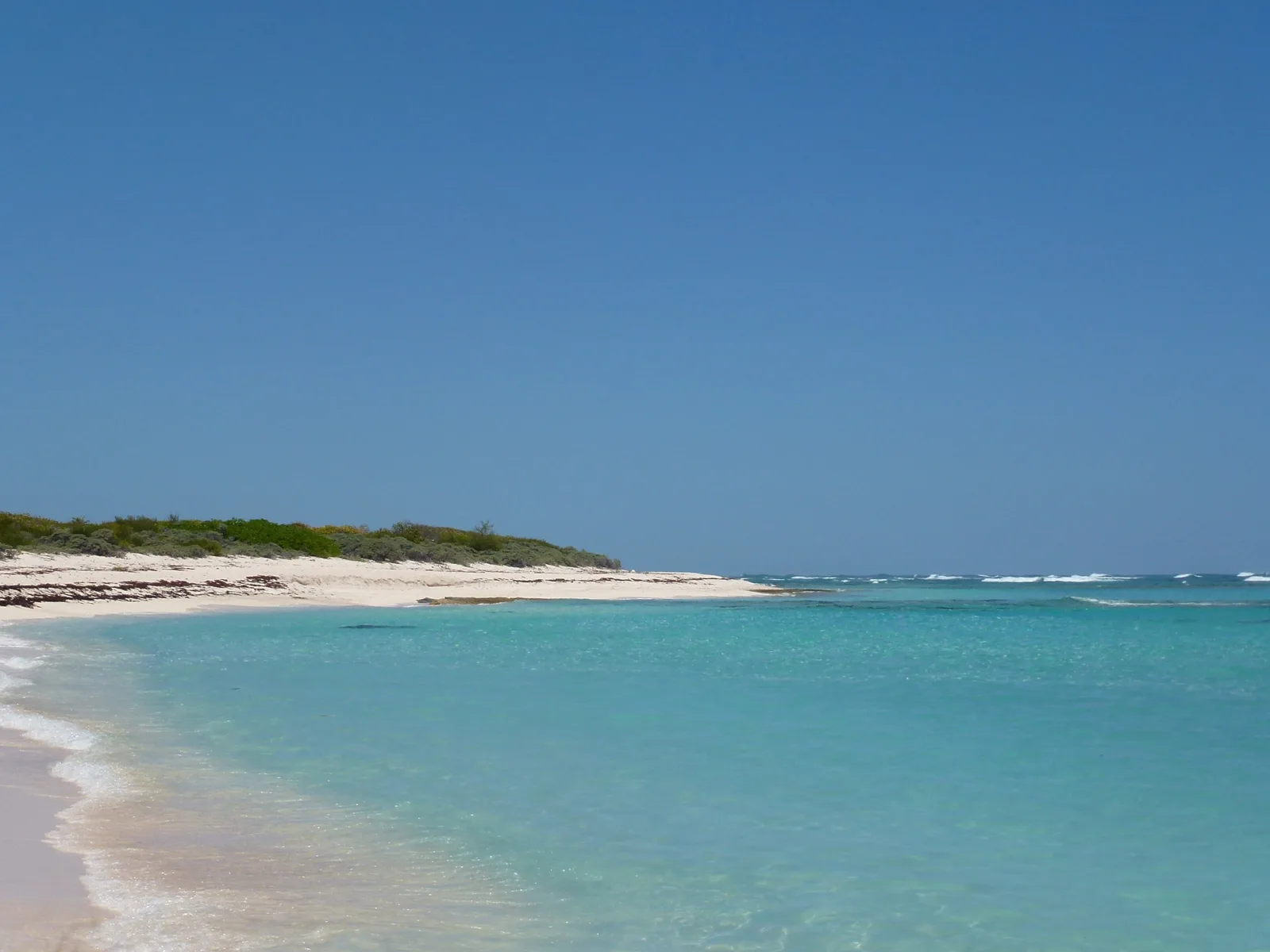
Ashore, take a taxi across the island to the beaches of the north shore. Anegada’s fishermen supply much of the fish and lobster for the rest of the BVI, so dinner is easy to choose.
Day 5: Anegada to Cane Garden Bay
This is the long leg, about 24 NM back south-west to the north shore of Tortola, usually a broad reach in the trade wind. Leave in the morning so that you arrive with plenty of daylight. Cane Garden Bay is a wide bay with a beach and moorings; it faces north-west, so check the forecast for northerly swell before you commit to the night.
Day 6: Cane Garden Bay to Jost Van Dyke
A short sail west brings you to Jost Van Dyke. Stop at Sandy Spit and White Bay for a swim, then spend the night in Great Harbour, which is also a port of entry with a customs office (BVI Tourism, arriving by sea).
Day 7: Jost Van Dyke to Road Town via Soper’s Hole
Sail south-east to Soper’s Hole at the West End of Tortola for lunch, then motor or beat back up the Sir Francis Drake Channel to Road Town. The Moorings asks sailing yachts to disembark by 11:00 on the last morning, so plan to be back on the base the evening before (The Moorings).
BVI mooring rules and fees for 2027
Fees below were checked in November 2026; the permit rates are set by the 2021 Act, so confirm them before you sail. Most nights in the BVI are spent on a mooring ball. Three types matter for this route.
| Type | Where | Overnight? | Typical cost |
|---|---|---|---|
| National Park moorings | The Baths, RMS Rhone, The Indians and other park sites | No, day use only | Covered by the National Parks permit on your charter invoice |
| Boatyball reservable moorings | Most popular bays (The Bight, Cooper, Cane Garden Bay, Great Harbour…) | Yes | About US$55 a night |
| First-come, first-served moorings | Same bays | Yes | About US$30–40 a night |
Prices for private moorings come from Sunsail’s guide to the Boatyball app, published in January 2026: reservable balls open in the app each morning, usually at 7 a.m., and you have a few minutes to pay once you select one (Sunsail, Boatyball tips). Anchoring is still possible outside many mooring fields, but never drop the anchor on coral, including Horseshoe Reef off Anegada.
The government fees are simpler than they look:
- Cruising permit: US$4 per person per day on a home-based (BVI) charter boat, US$16 on a foreign-based one, under the Cruising and Home Permit Act 2021 (Harneys, legal guide, November 2024). A yacht chartered from a Tortola base normally pays the home-based rate. The Moorings and Sunsail both include the cruising permit on your charter invoice; ask other operators how they charge it.
- National Parks permit: also on the invoice; it covers the day-use park moorings but not entry to The Baths.
- Environmental and Tourism Levy: US$10 per person on arrival, at every port of entry (The Moorings).
Who can sail this itinerary?
You do not need a formal licence to bareboat in the BVI with the big operators, but you must send a sailing résumé. The Moorings asks for at least 9 days and 100 miles as skipper on a similar yacht for its Level 1 rating, the level needed for the BVI (The Moorings, résumés and requirements). If your crew is new to sailing, compare the options in our bareboat vs crewed guide. Our catamaran vs monohull guide is written for Greece, but the trade-offs are the same in the BVI.
When to sail the BVI
Plan around two facts. The Atlantic hurricane season lasts from 1 June to 30 November, with the peak around 10 September and most activity between mid-August and mid-October (NOAA National Hurricane Center, climatology). Charter prices follow demand: on 12 Knots, average weekly prices across the BVI fleet are highest in March and lower in the off season (12 Knots, BVI, retrieved 3 November 2026).
Variations: shorter, gentler or longer
- Skip Anegada: spend a second night in North Sound, then sail west to Marina Cay or Trellis Bay at the east end of Tortola before Cane Garden Bay, which avoids the long open-water leg.
- Five days: Road Town, Norman Island, Cooper Island, The Baths and North Sound, then back down the channel. You stay inside the Sir Francis Drake Channel and along Virgin Gorda’s sheltered west coast, with no open-water legs.
- Ten days or more: add a night at Peter Island, a lay day in North Sound and a visit to Guana Island and Monkey Point on the way west.
Where to start: BVI charter bases
The big fleets are on Tortola. 12 Knots listed 670 boats in the BVI when we checked, with major bases at Nanny Cay, Hodge’s Creek and the marinas around Road Town, and weekly prices from about US$1,600 for a sailboat and US$3,400 for a catamaran (12 Knots, BVI, retrieved 3 November 2026). You can compare BVI charter boats and prices for your dates. The route above works from any of these bases; from Nanny Cay or Hodge’s Creek, adjust the first and last legs.
Getting to the marina
Most crews fly into Terrance B. Lettsome International Airport (EIS) on Beef Island, about 30 minutes by road from the Wickhams Cay bases (The Moorings). Sunsail sells shared transfers at US$16 per person and private transfers at US$50 per person for one or two passengers (Sunsail). The other route is via St Thomas in the US Virgin Islands and a daily ferry to Tortola. The Moorings warns that flights landing after about 4:30 pm usually mean a night in St Thomas (The Moorings). Before you leave home, use our yacht charter checklist for paperwork and packing.
Recommended reading
- The Cruising Guide to the Virgin Islands: the standard pilot for the BVI and USVI, regularly updated, with anchorages, mooring fields and approach sketches.
Links go to Amazon. As an Amazon Associate, Yacht Charter Guide earns from qualifying purchases.
Find your boat in the BVI
March is the peak month for prices, so book early if your dates fall then; outside the peak you have far more choice.
Frequently asked questions
How many days do you need to sail the BVI?
A week is enough to see the main islands: Norman, Cooper, Virgin Gorda, Jost Van Dyke and, if conditions allow, Anegada. Our loop covers about 85 NM in seven days with short daily legs. With five days, stay inside the Sir Francis Drake Channel; with ten, add Peter Island and lay days.
Can you stay overnight on National Park moorings in the BVI?
No. National Park moorings at sites such as The Baths and the RMS Rhone are for day use only. For the night, use a private mooring ball (about US$30–40 first-come or about US$55 reservable through Boatyball), a marina berth or an anchorage outside the coral.
Do you need a licence to bareboat charter in the BVI?
The big operators do not require a formal licence, but they check your sailing résumé. The Moorings asks for at least 9 days and 100 miles as skipper on a similar yacht. If your experience is short, hire a skipper for the first day or the whole week.
Is Anegada worth the sail?
Yes for confident crews in settled weather: the beaches and the lobster are the reward. The island is flat and surrounded by an 18-mile reef, so arrive in good light, follow the marked channel into Setting Point and check your charter company’s rules first. Otherwise, spend the extra night in North Sound.
When is the best time to sail the BVI?
Outside the Atlantic hurricane season, which runs from 1 June to 30 November and peaks between mid-August and mid-October. Charter prices on 12 Knots are highest in March.
Sources
- The Moorings, BVI travel information and résumés and requirements, retrieved 3 November 2026.
- Sunsail, BVI useful information, retrieved 3 November 2026, and Boatyball tips in the BVI, 14 January 2026.
- Harneys, Cruising and Home Permit Act 2021, legal guide, November 2024.
- National Parks Trust of the Virgin Islands, The Baths one-day pass, retrieved 3 November 2026.
- BVI Tourism, arriving by sea, retrieved 3 November 2026.
- NOAA National Hurricane Center, tropical cyclone climatology.
- 12 Knots, BVI yacht charter, retrieved 3 November 2026.
- Wikipedia, RMS Rhone and Anegada, retrieved 3 November 2026.
- Distances measured by Yacht Charter Guide on OpenStreetMap coastlines (© OpenStreetMap contributors).
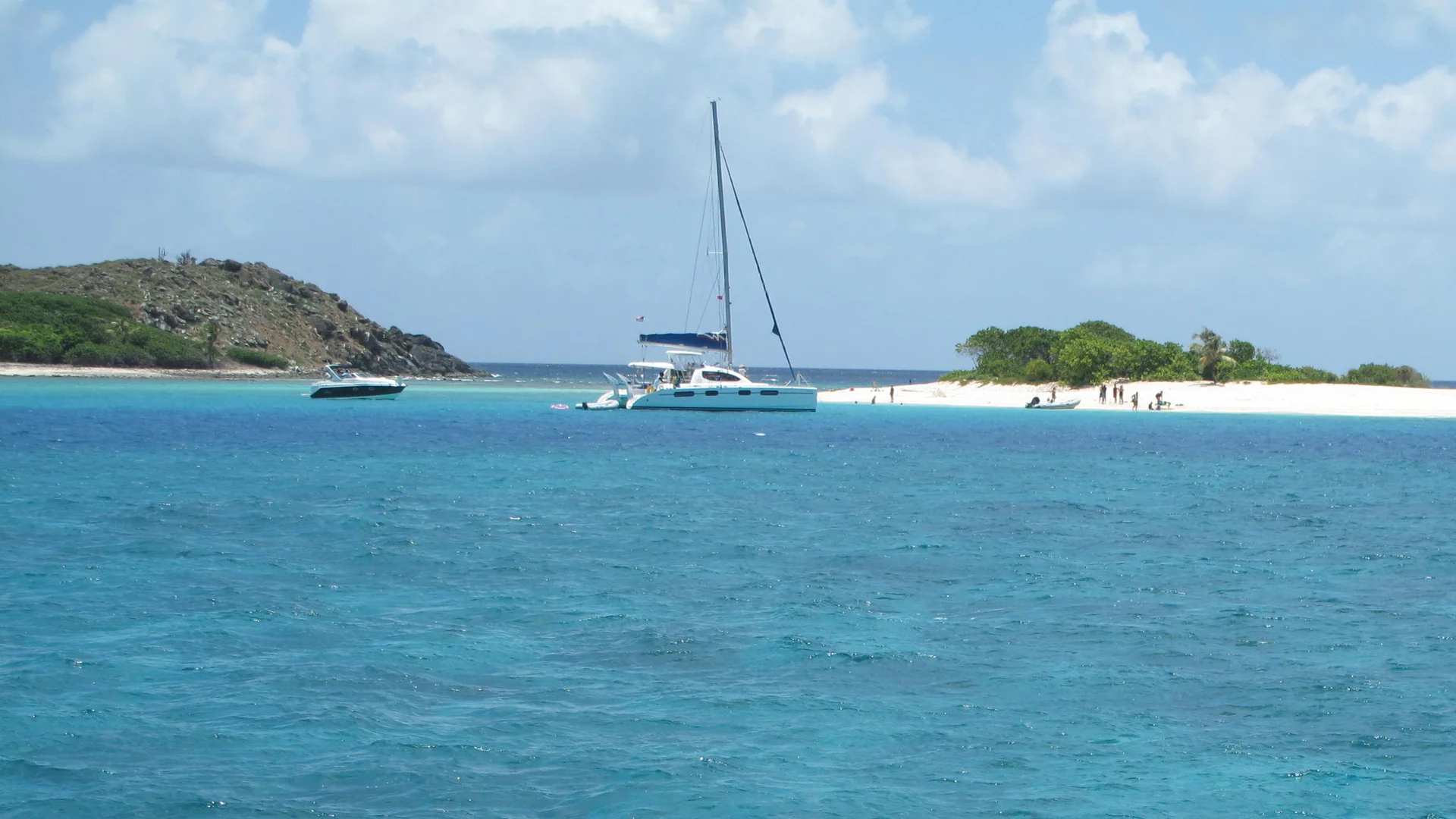
- Photos (via Wikimedia Commons): cover “Sandy Spit, Jost Van Dyke” by Fairphotos, CC BY 2.0, cropped; “Virgin Gorda – The Baths 2” by P. Hughes, CC BY-SA 4.0; “Loblolly Bay on Anegada” by Cayeldo, CC BY-SA 3.0.