Catamaran vs Monohull Charter in Greece
Most guides say a catamaran is simply “more comfortable” than a monohull. In Greece, that is only half the answer. Catamarans are about 29% of the boats available for charter (740 of 2,580 in 2023, according to Riginos data reported by GTP), and monohulls still make up the majority for practical reasons. Short answer: choose a catamaran for space, privacy and a stable ride at anchor, especially in the Ionian and the Saronic. Choose a monohull for the summer meltemi in the Cyclades or a tighter budget. Here is how to choose, with the prices and regions that matter for a yacht charter in Greece.
Key takeaways
- A catamaran costs 60–100% more than a monohull of the same length in Greece.
- Monohulls handle the summer meltemi of the Cyclades more predictably.
- Catamarans shine in the calmer Ionian and Saronic, for groups of 6 or more and for families.
- Catamarans are about 29% of the Greek charter fleet, so book early for July and August.
Why monohulls still dominate in Greece
The meltemi favours them. In the Cyclades, this summer wind can hold at 20–30 knots for days (Misios et al., Weather and Climate Dynamics). A heavier monohull cuts through the chop more predictably. A catamaran catches more wind and has no keel to stop it sliding sideways.
Greek ports were not built for wide boats. Most harbours are sized for monohulls moored stern-to. A catamaran takes up about two boat-widths. That is fine most of the year, but in a crowded August marina you need to arrive by 2–3pm, before the best spots fill.
Fleet economics. Catamarans cost more to build, maintain and berth. Outside the big hubs, operators run fewer of them than demand would justify, so you get less choice and need to book earlier.
Where each boat actually wins
| Catamaran | Monohull | |
|---|---|---|
| Space & privacy | wins clearly (near-double the living space, en-suite cabins common) | tighter, shared heads more common |
| Stability at anchor / no heeling | wins (flat, no leaning under sail) | heels under sail, more “sailing” motion |
| Handling in strong meltemi | struggles more (more windage, harder to anchor/dock in gusts) | handles chop and wind more predictably |
| Draft / anchoring close to shore | wins (shallower draft, tucks into small coves) | needs more depth |
| Charter cost | meaningfully more expensive | more affordable for the same length |
| Availability in Greece | limited, especially outside Athens/Lefkas hubs | wide availability |
| Sailing “purist” experience | less engaging for some sailors | wins, more classic sailing feel |
The real cost gap
Using two comparable 40-ft boats in peak season: a modern catamaran runs roughly €5,800/week, against roughly €3,000/week for an equivalent monohull, nearly double for a similar length. The averages tell the same story: in July, a catamaran week in Greece costs about €9,340 against €4,400 for a sailing monohull, more than double (October 2026 data) (12 Knots catamaran data and sailboat data). That premium buys space and stability, not speed. Full price ranges are on our Greece yacht charter cost page.
Why choose a catamaran charter in Greece?
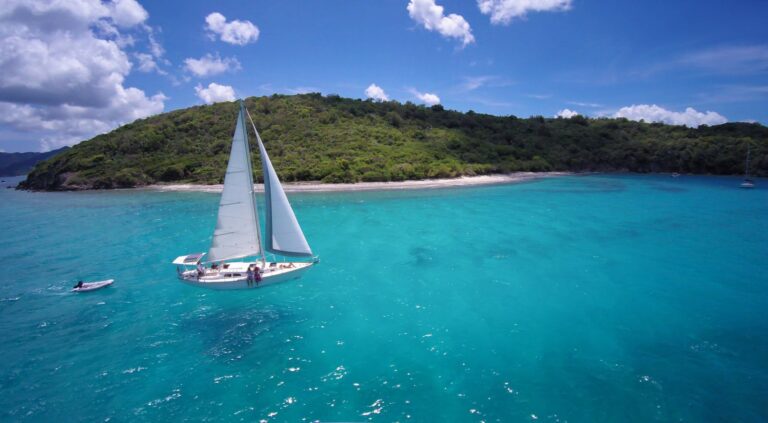
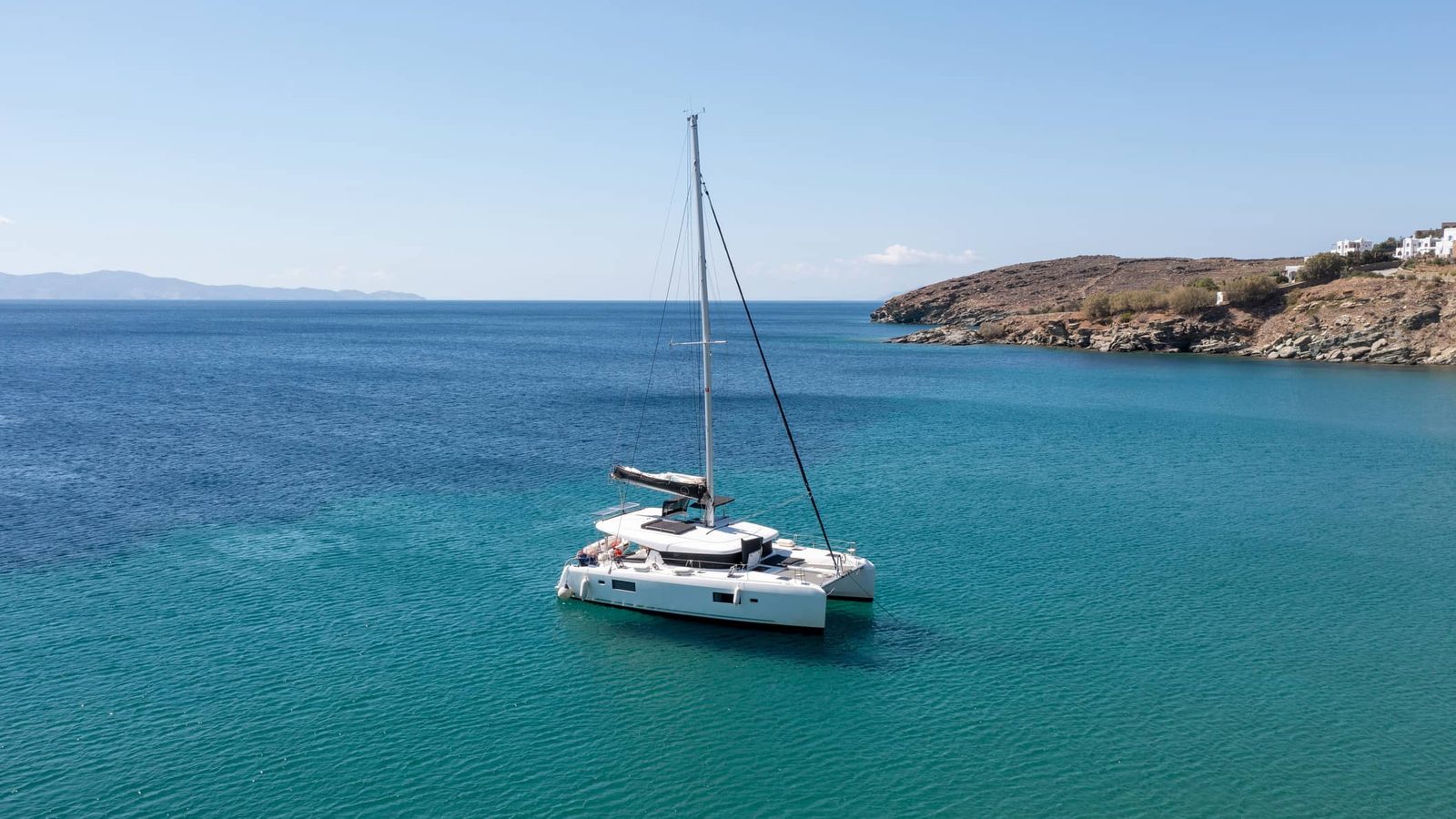
A catamaran stays flat at anchor, gives each couple a private cabin and bathroom, and draws only about 1.2–1.4 m, so you can anchor closer to the beach in shallow coves. Two engines make stern-to mooring easier. The trade-offs are the price, roughly 60–100% more than a monohull of the same length, the higher marina fees and a less lively feel under sail in the meltemi.
How to choose a catamaran charter in Greece
Decide in this order: your crew, the region, the season, then the boat. Most bad choices come from picking a boat first and a route second.
- Count cabins, not berths. Four couples fit a 42–46 ft catamaran with four double cabins and four heads. If you hire a skipper, add a cabin: the skipper needs one too.
- Pick the region before the boat. The Ionian and the Saronic Gulf suit a first catamaran week. The Cyclades in July and August need an experienced crew, because the meltemi can blow 20–30 knots for days.
- Choose the season with the budget in mind. In October 2026 data from 12 Knots, an average catamaran week in Greece cost about €8,400 in June, €9,340 in July and €9,540 in August, against about €6,440 in May.
- Check the build year and the kit. A boat from the last three years usually costs more but often has a watermaker, solar panels or a generator, which matter on a week at anchor.
- Compare the full price. The deposit or damage waiver, end cleaning, fuel, moorings and VAT change the total more than a few hundred euros on the base rate. Our Greece yacht charter cost guide lists every extra.
Where to charter a catamaran in Greece
- The Ionian Sea and Saronic Gulf: sheltered from the meltemi, calmer water, and the two regions where Greece’s catamaran fleet is actually concentrated. Lefkas and Athens (Alimos) offer the widest choice of catamarans for charter: see our guide to charter bases.
- Larger groups (8–12 people) who need multiple cabins with en-suite bathrooms and won’t tolerate sharing two heads between eight adults.
- Anyone prone to seasickness from heeling. A catamaran stays flat under sail, which is easier on a sensitive stomach in moderate conditions. In a short, choppy sea it can still jerk about, so it is not a cure.
Where a monohull is the better call
- The Cyclades in July–August, when the meltemi is at its strongest and a stable, weatherly boat matters more than cabin space.
- Couples or small families (up to 4 people): a 35–40 ft monohull is plenty of room and easier to single-hand in tight ports.
- Anyone chartering bareboat without deep experience: monohulls are more forgiving and more widely available if you need to swap boats or find local help.
- Tighter budgets: for the same length, a catamaran typically costs 60–100% more to charter than a monohull.
Planning a multihull week? See our catamaran charter guide for Greece for prices, regions and boats.
Recommended reading
- RYA Day Skipper Handbook (Sail): the course book behind the most common charter licence, useful as a refresher before a bareboat week.
- Greek Waters Pilot (Imray, Rod and Lucinda Heikell): the standard pilot book for harbours and anchorages across Greece.
Links go to Amazon. As an Amazon Associate I earn from qualifying purchases.
Getting to the marina
Most bareboat and skippered charters in Greece start from Athens (Alimos or Lavrion), Lefkas or Corfu. Book the airport transfer before you fly so the driver meets you at arrivals: transfers from Athens airport, Preveza airport for Lefkas and Corfu airport.
Frequently asked questions
Is a catamaran harder to sail in Greece than in the Caribbean?
Catamaran handling is more demanding in the Cyclades than in the Caribbean, mainly because of the strong meltemi and Greek marina layouts that were not designed for wide multihulls.
How much more does a catamaran cost to charter in Greece?
Usually 60–100% more than a monohull of comparable length. The premium comes from the boat’s size, its two engines and strong demand for a smaller catamaran fleet.
Catamaran or monohull: which is better for a family with young children?
A catamaran, in most cases. Its flat, stable motion and extra living space are easier to manage with kids than a monohull that heels under sail.
Where is the best place to charter a catamaran in Greece?
Athens (Alimos and Lavrio) and Lefkas in the Ionian have the largest catamaran fleets, with the widest availability outside peak season.
How do you choose a catamaran charter in Greece?
Start with the crew (one double cabin per couple, plus one for a skipper), then the region (Ionian or Saronic for a first week, Cyclades for experienced crews), then the season and the budget. Only then compare boats, by build year, equipment and the full price including extras.
Sources
- GTP Headlines, Greece leading the way in yacht charter availability (17 January 2024).
- Weather and Climate Dynamics (Copernicus), Misios et al., etesian (meltemi) climatology, preprint wcd-2022-16.
- 12 Knots, Catamaran rentals in Greece 2027 and Sailboat rentals in Greece 2027.
- All links checked on 1 November 2026.