Catamaran Charter in Greece: Prices, Regions & Boats
A bareboat catamaran charter in Greece costs roughly €5,500–€8,000 a week in shoulder season and €7,000–€11,000 in July and August for a 42–46 ft boat, and €12,000–€20,000 in high season for a 50-footer. Add €180–€250 a day if you want a skipper, or roughly €2,500–€3,500 a week for a skipper and a cook. Catamarans are a minority of the Greek charter fleet and in heavy demand, so the right boat for peak weeks is usually gone six to nine months ahead.
This guide covers what a catamaran charter in Greece really costs, which regions suit a multihull, the boats you will find in charter fleets, and how sailing a cat in Greek harbours differs from a monohull. If you are still deciding between the two, start with our catamaran vs monohull comparison; for the wider picture, see our guide to yacht charter in Greece.
How much does a catamaran charter in Greece cost in 2027?
Prices depend on the length of the boat, its age and the week you sail. These ranges are weekly charter fees for bareboat catamarans, before extras.
| Shoulder season (May, June, September) | High season (July, August) | |
|---|---|---|
| Catamaran 42–46 ft (4 cabins) | €5,500–€8,000 | €7,000–€11,000 |
| Catamaran 50 ft and over (4–6 cabins) | €8,000–€13,000 | €12,000–€20,000 |
Low season (April and October) can drop a 42–46 ft cat to €3,500–€5,500. Newer boats sit at the top of each range, and the newest or best-equipped models can go beyond it in the peak weeks of mid-July to mid-August.
The extras to add to the charter fee
- Security deposit: typically €2,000–€6,000, often at the top of that range for a catamaran. Most operators let you replace it with a non-refundable damage waiver of a few hundred euros a week.
- Charter or comfort package: end cleaning, bed linen, towels and the outboard for the tender, usually €250–€600 a week on a cat.
- Fuel: two engines instead of one. Under sail a cat burns little, but a week of motoring in light wind adds up.
- Moorings: ports and marinas usually charge a catamaran more than a monohull of the same length, because of the extra beam.
- VAT: 12% on most Greek charters. Check whether your quote includes it.
Our Greece yacht charter cost breakdown covers every extra in detail, for monohulls and catamarans alike.
Bareboat, skippered or crewed catamaran?
The same catamaran can be chartered three ways. The format changes the price, the licence you need and how much work you do on board.
| What you get | Licence needed | Extra cost | |
|---|---|---|---|
| Bareboat | The boat only; you sail it yourself | Yes, plus a second crew member | None |
| Skippered | A professional skipper; you cook and provision | No | €180–€250 a day plus the skipper’s food |
| Crewed | Skipper and hostess or cook; meals prepared on board | No | €2,500–€3,500 a week, plus an APA for food and fuel |
A crewed catamaran is closer to a small floating hotel than a rental, and the all-in gap with bareboat is smaller than the charter fee suggests once you price in food, fuel and moorings. We set out the full calculation, on a real Lagoon 50, in our bareboat vs crewed comparison.
Where to charter a catamaran in Greece
Greece’s catamaran fleet is concentrated where the water is calmest. The region you choose matters more on a cat than on a monohull, because a wide, high boat feels strong wind more.
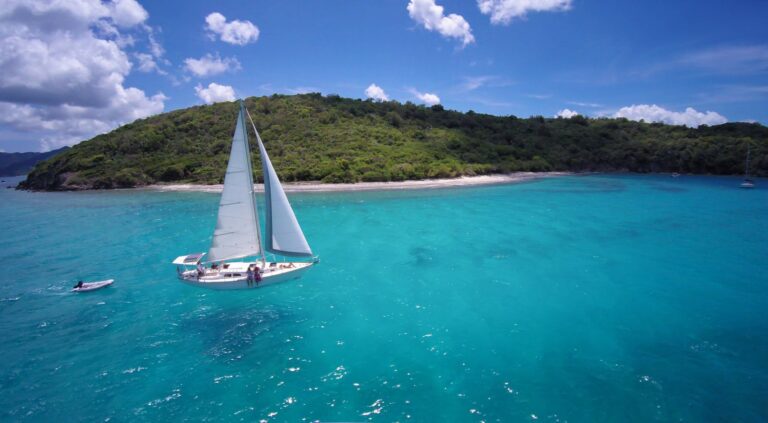
- Ionian Sea (Lefkas, Corfu, Kefalonia): the best region in Greece for a catamaran. No meltemi, short legs, sheltered bays where a cat’s shallow draft lets you anchor close to the beach. Lefkas has one of the largest catamaran fleets in the country.
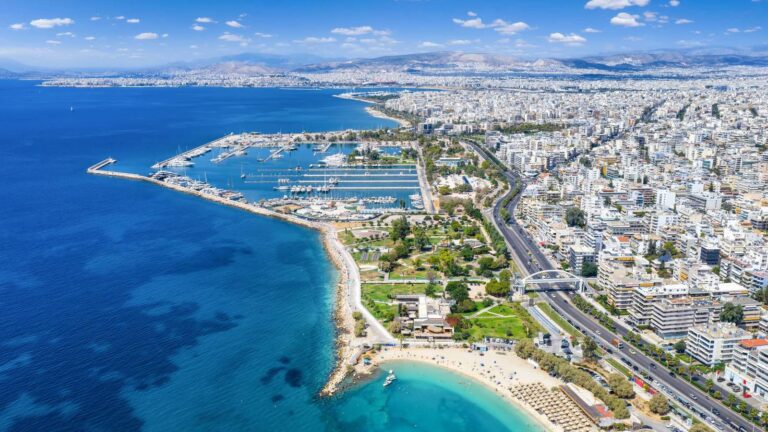
- Saronic Gulf (Athens): the easiest start, from Alimos marina, about 40 minutes from Athens airport. Calmer than the Cyclades, though Hydra’s harbour is tight for a wide boat.
- Cyclades (from Athens, Lavrio or Paros): the most beautiful and the most demanding. In July and August the meltemi can blow 25–30 knots for days; a cat handles it with an experienced crew and early reefs, but it is not the place for a first multihull week. Our 7-day Cyclades sailing itinerary shows how to plan around the wind.
- Dodecanese (Kos, Rhodes): good fleets and lively islands, with a strong summer wind in the north of the chain.
For pick-up logistics, airports and fleet sizes, see our guide to charter bases in Greece.
Which catamarans will you find in Greek charter fleets?
Charter fleets in Greece are built around a handful of production catamarans. Knowing the names helps you compare quotes like for like.
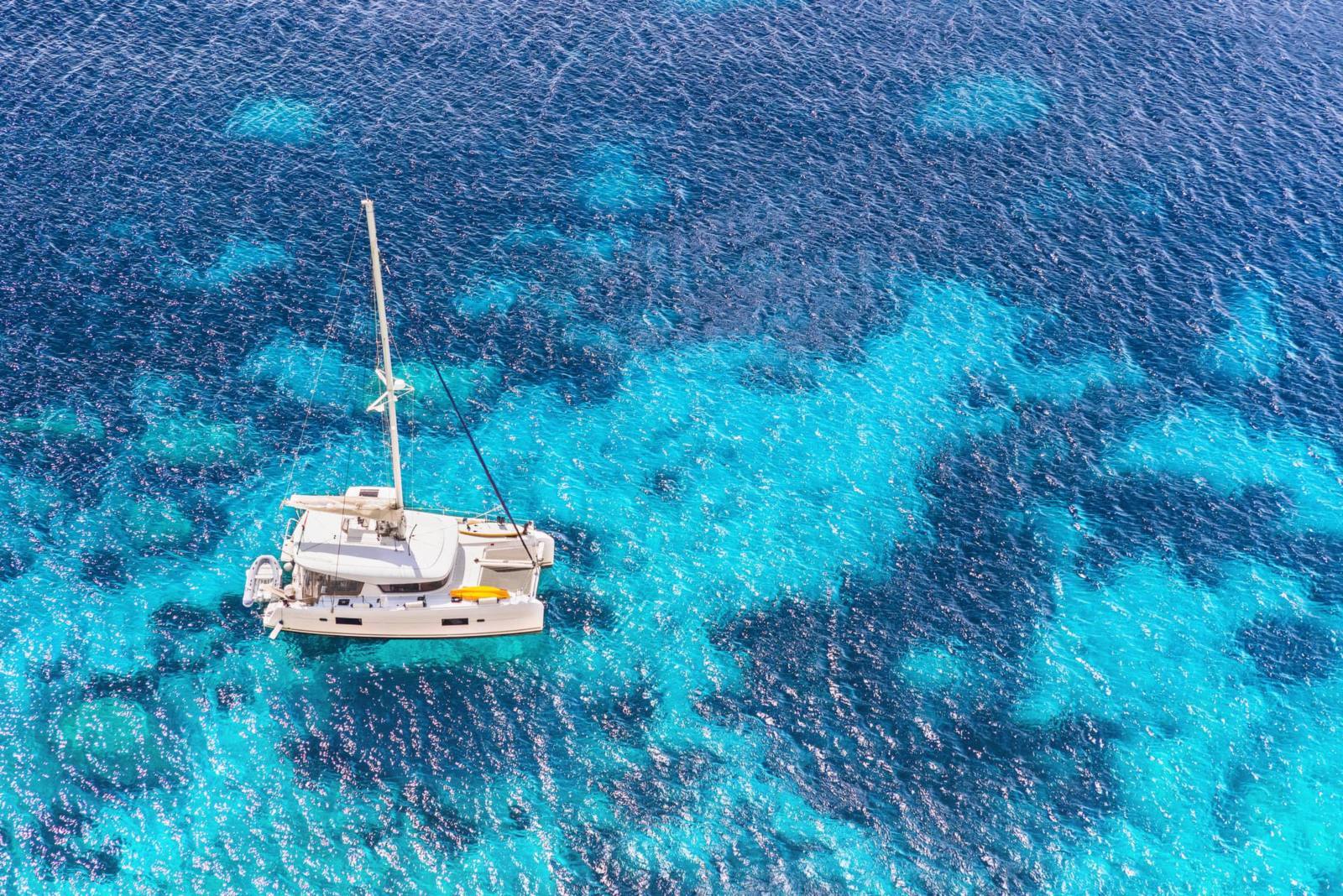
- Lagoon 40, 42 and 46: the most common charter catamarans in Greece. Four cabins, four heads, room for 8–10 guests.
- Bali 4.2 and 4.6: recognisable by the opening front door to the foredeck lounge; very open living space.
- Fountaine Pajot (Astréa 42, Elba 45, Saona 47): slightly more performance-minded, with good light-wind sailing.
- Lagoon 50 and larger: five or six cabins, often with crew quarters. The usual choice for crewed charters and big groups.
A boat from the last three to four years costs more but usually comes with a watermaker, solar panels and a generator on larger models. On an older boat, ask what is broken before you sign, not after.
Sailing a catamaran in Greece: what changes
A catamaran is easier to live on and, in many ways, easier to manoeuvre. Greek conditions add a few rules that first-time multihull skippers learn quickly.
- Mooring stern-to: most Greek harbours use stern-to mooring with your own anchor. Two engines make a cat very precise in reverse, but the boat takes up almost two monohull widths, so arrive by 2–3 pm in July and August.
- Reef by the numbers: a catamaran does not heel to warn you it is overpowered. Reef at the wind speed set in your boat’s handbook, not by feel, especially in the meltemi.
- Anchoring: always use the bridle, and choose bays sheltered from the afternoon wind direction.
- Shallow draft: around 1.2–1.4 metres on most charter cats, which opens up coves a deep-keeled monohull has to skip.
For a bareboat catamaran charter, the licence rules are the same as for a monohull: a recognised qualification such as the ICC, and a second named crew member. Some operators also ask for previous multihull experience on your sailing CV. See our licence requirements for Greece.
Is a catamaran charter in Greece right for you?
A catamaran makes the most sense for groups of 6–10, families with young children, anyone prone to seasickness from heeling, and crews who will spend more time at anchor than sailing hard. It makes less sense for a couple on a budget, or for an inexperienced crew set on the Cyclades in August.
If you choose one, book early, favour the Ionian or the Saronic for a first week, and compare at least two or three quotes on the same model so the extras are easy to spot.
Frequently asked questions
How much does it cost to charter a catamaran in Greece for a week?
A 42–46 ft bareboat catamaran costs roughly €5,500–€8,000 a week in shoulder season and €7,000–€11,000 in July and August, before extras such as fuel, moorings, cleaning and VAT. A 50 ft catamaran costs €12,000–€20,000 a week in high season.
Do you need a licence to charter a catamaran in Greece?
Only for a bareboat charter, where you skipper the boat yourself. You need a recognised qualification such as the ICC and a second named crew member. Skippered and crewed catamaran charters require no licence.
Where is the best place to charter a catamaran in Greece?
The Ionian Sea, based in Lefkas or Corfu, is the best region for a catamaran: no meltemi, short legs and sheltered bays. The Saronic Gulf, from Athens, is the easiest alternative.
Is a catamaran a good choice for the Cyclades?
Yes for an experienced crew in June or September. In July and August, the meltemi makes the Cyclades demanding on a catamaran, so a skipper or a calmer region is the safer choice.
How far ahead should you book a catamaran charter in Greece?
For July and August, six to nine months ahead. Catamarans are a small share of the Greek fleet and the best boats go first. For June and September, three to four months is usually enough.