7-Day Cyclades Sailing Itinerary: A Realistic Week by Yacht
This itinerary is a round trip from Vlychada Marina on Santorini, using legs of 8 to 38 nautical miles and moving from the most exposed crossing on day one to sheltered anchorages later in the week. Total distance is roughly 205 nautical miles over seven nights. It works in June and September; in July and August, treat every day as a plan A with a plan B. It is one of the classic routes for a yacht charter in Greece.
Key takeaways
- A 7-night round trip from Santorini: about 205 NM in legs of 8–38 NM.
- The roughest crossing (Santorini to Folegandros) comes first; the end of the week is sheltered.
- In July and August the meltemi can blow 30 knots: sail long legs in the morning and keep a plan B.
- Better for crews with some experience or a hired skipper; beginners should choose the Ionian or Saronic.
Starting from Paros or Mykonos instead? The same loop works from either island: join it at Paros or Naxos and sail it in the same order. For a Mykonos start, our Mykonos yacht charter guide sets out the nearby routes.
The route
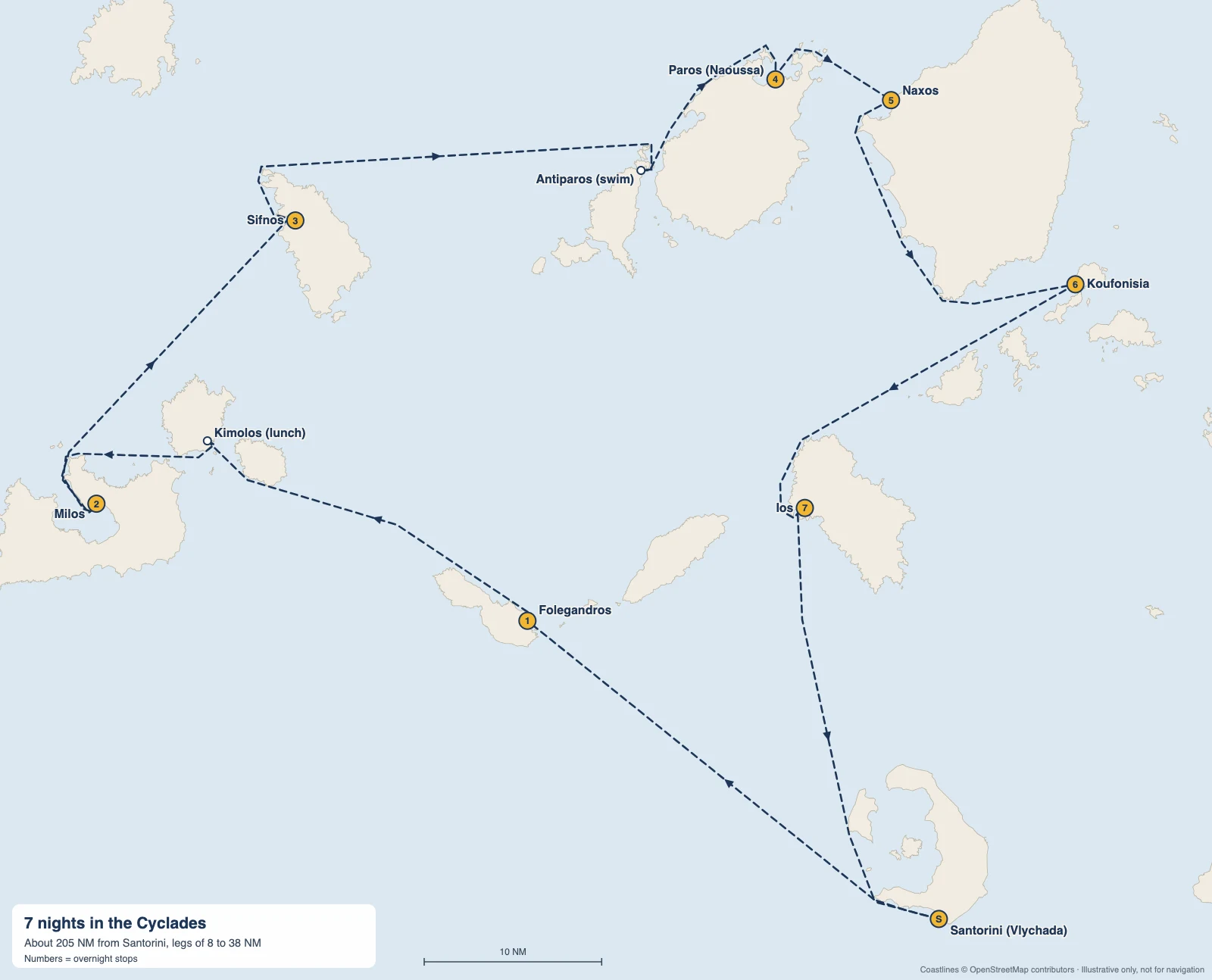
Day 1: Santorini to Folegandros (about 29 NM). Board at Vlychada (see our Santorini yacht charter guide), cast off as early as you can: it takes five to six hours. This is the roughest crossing of the week. Arrive at Chora, the clifftop village, in the evening.
Day 2: Folegandros to Milos via Kimolos (about 35 NM). Stop at Kimolos for lunch at anchor, then on to Milos: Sarakiniko’s white rock, Kleftiko sea caves and the Klima boathouses.
Day 3: Milos to Sifnos (about 23 NM). A morning sail to the island known for its food. Overnight at Kamares.
Day 4: Sifnos to Paros via Antiparos (about 38 NM, the longest day; skip Antiparos and sail straight to Parikia to cut it to about 29 NM). Swim at the Antiparos coves, then on to Naoussa on Paros and its Venetian harbour.
Day 5: Paros to Naxos (about 8 NM from Naoussa). Lunch on the west coast beaches, then explore the Portara gate and the old town.
Day 6: Naxos to Koufonisia and Schinoussa (about 20 to 21 NM). The Small Cyclades are made for yachts: sea caves, rock pools and turquoise water.
Day 7: Koufonisia/Schinoussa to Ios (about 22 to 24 NM). Ios has a proper harbour, Chora’s maze of steps and churches, and beaches at Mylopotas and Manganari.
Day 8: Ios to Santorini (about 27 NM). A calmer return crossing. Aim to disembark by midday.
| Day | Leg | Distance | Highlight |
|---|---|---|---|
| 1 | Santorini to Folegandros | 29 NM | Chora on the cliffs |
| 2 | Folegandros to Milos via Kimolos | 35 NM | Sarakiniko, Kleftiko |
| 3 | Milos to Sifnos | 23 NM | Food, Kamares |
| 4 | Sifnos to Paros via Antiparos | 38 NM | Naoussa harbour |
| 5 | Paros to Naxos | 8 NM | Portara, old town |
| 6 | Naxos to Koufonisia or Schinoussa | 20–21 NM | Small Cyclades |
| 7 | Koufonisia or Schinoussa to Ios | 22–24 NM | Chora, Manganari |
| 8 | Ios to Santorini | 27 NM | Return to Vlychada |
Wind: how to adapt the route
The meltemi decides this week (see the best time to sail in Greece). This northerly wind peaks in July and August and often tops 15 m/s, about 30 knots, over the Aegean (Misios et al., Weather and Climate Dynamics). Sail long legs, especially the Folegandros crossing on day one, in the morning calm. In strong wind, reorder stops rather than fight it. The route moves from exposed to sheltered water, so shorten the exposed legs but keep the sheltered days. A monohull handles the day-one crossing better than most catamarans.
Check the forecast every morning. The official source is the Hellenic National Meteorological Service (EMY), and the POSEIDON forecast of the Hellenic Centre for Marine Research shows wind and wave height for each part of the Aegean.
Practical notes
Vlychada is small, so provisioning is slower in peak season and some boarding may be by dinghy: confirm logistics with your operator. Plan an extra night ashore before a long-haul flight home.
If you would rather avoid the exposed first crossing, start in Paros and run the second half of the route first, or choose the Saronic or Ionian instead.
Recommended reading
- Greek Waters Pilot (Imray, Rod and Lucinda Heikell, 15th edition, 2025): the standard harbour-by-harbour guide to Greece, with plans of most anchorages and town quays.
Links go to Amazon. As an Amazon Associate I earn from qualifying purchases.
Getting to the marina
This loop starts in Santorini. Book the airport transfer before you arrive so the driver meets you at arrivals: transfers from Santorini airport. Starting from Athens instead? See Athens airport transfers.
Frequently asked questions
Can you sail a 7-night Cyclades itinerary on a catamaran?
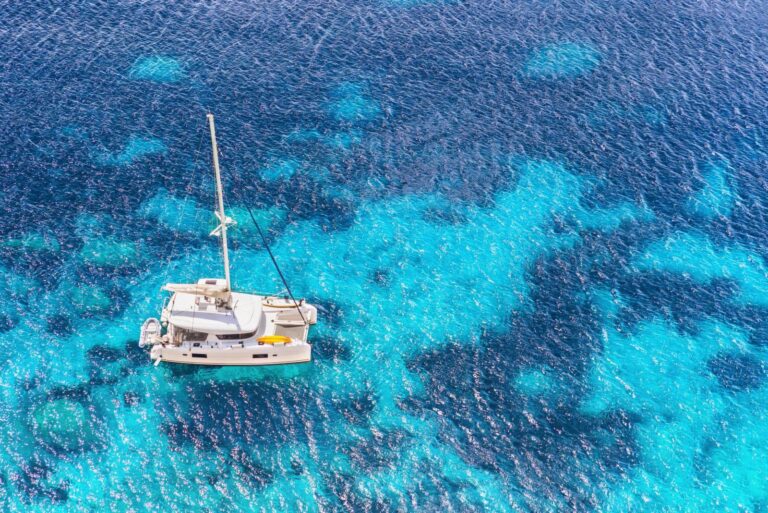
Yes, but book early and, in high season, plan to reach harbours by mid-afternoon to find space. See our catamaran vs monohull guide.
Is a Cyclades sailing itinerary suitable for beginners?
It is better suited to crews with some experience or a hired skipper. For a first week, the Ionian and the Saronic Gulf are easier.
How much does a 7-night Cyclades yacht charter cost?
The charter fee follows the prices in our Greece cost guide. Add fuel, mooring fees, provisioning and end cleaning, and check whether VAT is included in the quote.
What if the meltemi blows for several days in the Cyclades?
Shorten your legs, stay in sheltered ports, and use the Small Cyclades and Sifnos as fallback stops until the wind eases.
Sources
- Weather and Climate Dynamics (Copernicus), Misios et al., etesian (meltemi) climatology, preprint wcd-2022-16.
- Hellenic National Meteorological Service (EMY), forecasts and warnings.
- Hellenic Centre for Marine Research, POSEIDON forecasting system.
- Distances and route maps by Yacht Charter Guide on OpenStreetMap coastlines (© OpenStreetMap contributors).
- All links checked on 1 November 2026.