Croatia Island Hopping by Boat: Ferry, Cruise or Charter? (2027 Prices)
There are five ways to go island hopping in Croatia: public ferries and fast catamarans, a small-ship cruise, a crewed gulet, your own chartered sailboat or catamaran, and day trips by speedboat. Ferries are the cheapest (about €6 to €30 a crossing in 2026) but tie you to timetables and ports. A small-ship cruise costs roughly €700 to €1,750 per person for a week and does the planning for you. A chartered yacht costs more up front but, split between 6 to 8 friends, it often lands close to a cruise and gives you something neither can: empty bays, your own schedule and a different harbour every night. This guide compares all five with real prices, then shows a classic route from Split.
Key takeaways
- Ferries and fast catamarans: cheapest and simplest for 2 to 3 islands, about €6 to €30 per crossing, but you sleep ashore and follow the timetable.
- Small-ship cruise: about €689 to €1,739 per person for 8 days with Sail Croatia in 2026, cabin and most lunches included, dinners extra.
- Private yacht charter: the most freedom; a 46 ft monohull costs about €2,200 to €5,400 a week in 2027 before extras, so roughly €450 to €900 per person for a group of 8.
- No sailing licence? Add a skipper for about €150 to €250 a day plus food.
- The classic route links Split, Brač, Hvar, Vis, Korčula, Mljet and Dubrovnik; most islands are 1 to 4 hours apart by boat.
The five ways to island hop in Croatia, compared
Croatia has more than 1,000 islands, islets and reefs, but only about 50 are inhabited and most visitors focus on a dozen of them in Central and Southern Dalmatia. How you travel between them changes the whole trip more than which islands you pick.
| Option | Typical cost | Freedom | Where you sleep | Best for |
|---|---|---|---|---|
| Ferry and fast catamaran | €6 to €30 per person per crossing | Low: fixed timetables and ports | Hotels and apartments | Couples and solo travellers visiting 2 to 3 islands |
| Small-ship cruise | €689 to €1,739 per person per week (2026) | Low: fixed route | Cabin on board | Couples, solo travellers, groups who want it all organised |
| Crewed gulet | About €21,000 to €25,500 per boat per week | High: you agree the route with the captain | Private cabins | Families and groups of 10 to 12 with a bigger budget |
| Yacht charter (bareboat or skippered) | About €1,800 to €12,900 per boat per week (2027) | Very high | Your own boat, a new harbour or bay every night | Groups of friends and families of 4 to 10 |
| Day speedboat | From about €130 to €400 per boat per day | High, but only for a day | Ashore | Adding one or two islands to a land-based holiday |
Option 1: ferries and fast catamarans
Three operators cover most island routes from Split and Dubrovnik: the state company Jadrolinija (car ferries and catamarans), Kapetan Luka, also sold as Krilo, and TP Line (fast passenger catamarans). Car ferries run all year, less often in winter; most fast catamarans run from about April to October.
| Route | Time | Foot passenger fare (2026) |
|---|---|---|
| Split to Supetar (Brač) | 20 to 50 min | €6.50 ferry, €10 catamaran |
| Split to Hvar town | about 1 h | about €25 by catamaran in summer |
| Split to Vis | 1 h 10 by catamaran, 2 h 20 by ferry | €9.10 ferry, €10 to €28 catamaran |
| Split to Korčula | 1 h 45 (Vela Luka) to 3 h 15 | about €30 |
| Dubrovnik to Korčula | about 1 h 45 to 2 h | about €25 |
Pros: cheap, frequent on short routes (Split to Brač runs many times a day), no planning beyond a ticket. Cons: you see the islands from the ports only, you carry luggage between hotels, and in July and August catamarans and island rooms sell out. Foot passengers always get on a car ferry, but cars are only guaranteed a space where the line takes reservations, so National Geographic advises leaving the car on the mainland if you can.
Option 2: a small-ship cruise
Small cruise ships of 20 to 40 cabins sail a fixed weekly loop, usually Split to Dubrovnik or back, stopping at Hvar, Korčula, Mljet and Brač with swim stops on the way. According to Sail Croatia, an 8-day cruise costs from €689 per person on its budget Navigator boats to €1,739 on its Elegance ships in 2026. The cabin, breakfast, lunch and a tour manager are included; dinners, drinks, excursions and a local payment of €40 to €50 are not.
Pros: everything is organised, you unpack once, and it works for a solo traveller or a couple. Cons: the route is fixed, you moor in busy town harbours next to other cruise boats, and you share the ship with strangers. Some lines are known as party cruises, so read the boat description carefully.
Option 3: a crewed gulet
A gulet is a traditional wooden motor-sailer of 20 to 35 metres with a captain, a cook and deckhands. You book the whole boat, usually for 8 to 12 guests, and agree the route with the captain. The 12knots average across 63 gulets in Croatia is about €21,000 to €25,500 a week, before food, fuel and port fees. For 12 people that is roughly €1,700 to €2,100 each, comparable to a premium cruise but on a private boat.
Option 4: charter your own sailboat or catamaran
This is how most sailors see the islands: you rent a boat for a week, Saturday to Saturday, from a base such as Split, Trogir or Dubrovnik. You decide each morning where to go, swim in bays the ferries never reach, and spend the night at a town quay, a marina or on a mooring buoy. You can sail it yourself (bareboat) with a recognised skipper licence and a VHF radio certificate, or hire a local skipper.
- Price per boat: a 38 ft monohull costs about €1,800 a week in spring and €4,400 in peak summer 2027; a 46 ft monohull with five cabins about €2,200 to €5,400; a Lagoon 46 catamaran about €4,700 to €12,900 (yacht-rent 2027 lists).
- Extras: a mandatory charter pack for cleaning and linen (about €300 to €600), fuel, berths (often €60 to €160 a night for a monohull, about double for a catamaran) and a small tourist tax.
- Skipper: about €150 to €250 a day plus his food, according to SkipperCity and the 2027 lists.
For 8 friends on a five-cabin monohull in June, the boat and extras usually come to €600 to €900 per person for the week, about the price of a mid-range cruise cabin, with far more freedom. Our Croatia yacht charter cost guide breaks this down line by line, and the catamaran charter guide explains when a catamaran is worth the extra.
To compare boats and prices for your dates, you can search sailboats and catamarans in Croatia.
Option 5: a speedboat for the day
If you are staying in one place, a day boat adds the islands you would otherwise miss: the Pakleni Islands from Hvar, the Blue Cave from Vis, or the Elaphites from Dubrovnik. On Click&Boat, licence-free boats start at about €130 to €200 a day, often with fuel included, and larger RIBs cost about €330 to €400. Summer prices are higher, so book a few days ahead. You can compare day boats on Click&Boat.
Which islands to choose
| Island | Known for | From Split by boat |
|---|---|---|
| Brač | Zlatni Rat beach at Bol, Milna harbour | Milna about 11 NM, Bol about 23 NM |
| Hvar | Hvar town nightlife, the Pakleni Islands, quiet Stari Grad | about 21 to 23 NM |
| Šolta | Small villages, Maslinica bay | about 13 NM |
| Vis | Remote and unspoilt, the Blue Cave on nearby Biševo | about 30 NM |
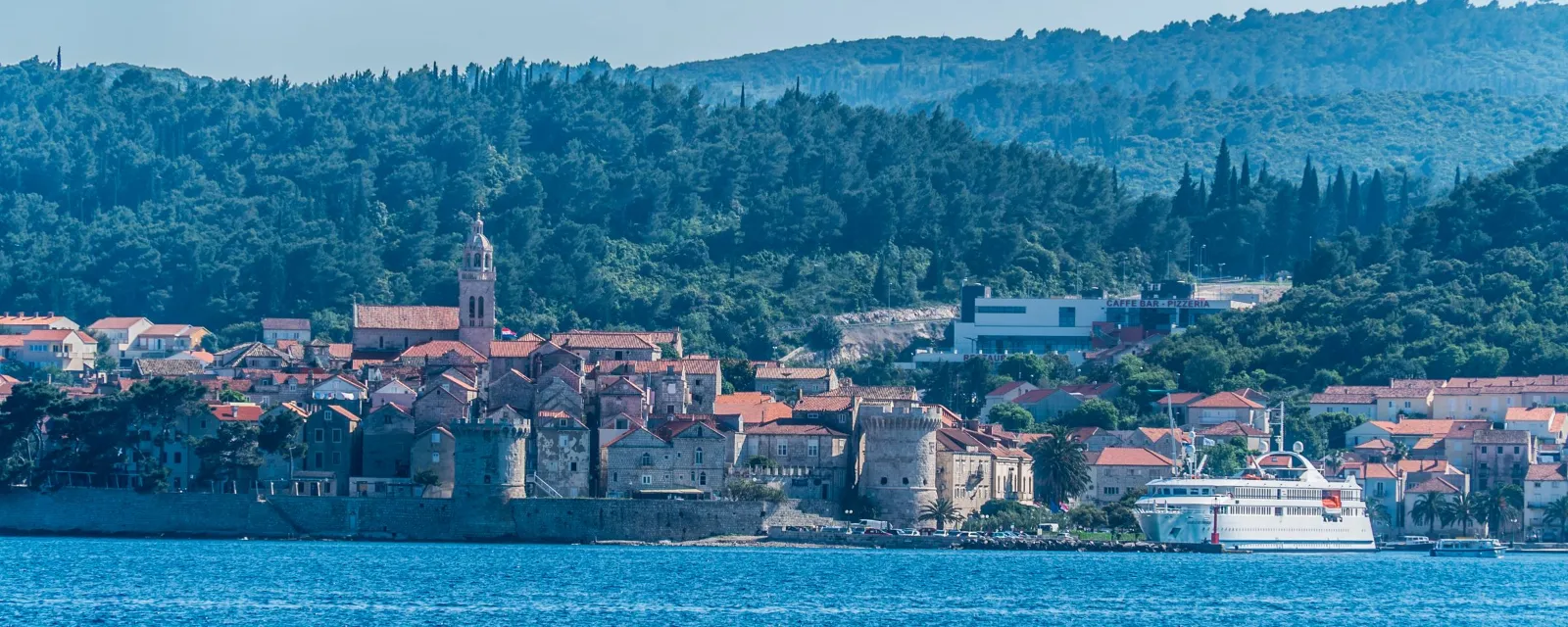
| Korčula | Walled old town, wine villages | about 55 NM |
| Mljet | National park with saltwater lakes | about 70 to 75 NM, closer from Dubrovnik |
| Lastovo | Nature park, the most remote inhabited group | about 50 to 55 NM |
A classic island hopping route by boat
With your own boat, the best-known week is a loop from Split: Šolta, Vis and the Blue Cave, Komiža, the Pakleni Islands off Hvar, Stari Grad and back via Brač, about 115 NM with legs of 13 to 26 NM. We describe it day by day, with a map, moorings and a plan B for bad weather, in our 7-day sailing itinerary from Split. If you start in the south, the 7-day itinerary from Dubrovnik covers the Elaphites, Mljet, Korčula and Lastovo.
By ferry, the classic order is the one Rough Guides suggests: Split, Brač, Hvar, Korčula and Dubrovnik, with 2 or 3 nights on each island. Check that each connection runs on your day before you book rooms, especially outside summer.
When to go
June and September are the sweet spot: warm sea, a steady afternoon maestral for sailing, and fewer crowds and lower prices than July and August. Peak summer is the busiest and most expensive time on ferries, in island hotels and on charter boats alike. In May and October, many fast catamarans run reduced timetables and some island restaurants are closed. Our guide to the best time to sail in Croatia goes month by month.
Getting to the starting point
Split and Dubrovnik airports are the two main gateways. Ferries and catamarans leave from the city ports, close to the old towns. Charter boats leave from marinas: ACI Split and the Split city marinas, Trogir and the Kaštela marinas near Split airport, and ACI Dubrovnik at Komolac, about 6 km up the river from the old town. Boarding is usually from 3 pm on Saturday. With luggage and a week of provisions, the simplest option is a pre-booked transfer: you can book an airport transfer in Split at a fixed price.
Tips for island hopping in Croatia
- Book ahead in July and August: island accommodation is limited (National Geographic counts one hotel each on Šolta and Mljet), and good charter boats go months in advance.
- Pack light and soft: a soft bag fits on a boat and on a crowded catamaran far better than a hard suitcase.
- Bring water shoes: most beaches are shingle or rock, with sea urchins on the rocks.
- Budget for park tickets: Mljet National Park charges each visitor €30 in summer 2026, and boats pay a separate fee to anchor in the park.
- Keep a weather day: a bora or jugo can stop small boats and some catamaran lines. Our article Is it safe to sail in Croatia? explains the winds.
Useful to bring
- A waterproof phone pouch with a lanyard: take photos while swimming without risking your phone.
- A 20 L dry bag: keeps phones, wallets and cameras dry on the tender or a day boat.
- Acupressure wristbands: a drug-free first defence against seasickness on windy days.
Links go to Amazon. As an Amazon Associate I earn from qualifying purchases.
Weighing a small-ship cruise against your own boat? Our Croatia cruise vs yacht charter comparison sets out prices and routes.
Frequently asked questions
What is the best way to island hop in Croatia?
For 2 or 3 islands on a budget, ferries and fast catamarans. For a week with no planning, a small-ship cruise. For a group of friends or a family who want freedom and quiet bays, a chartered yacht, with a skipper if nobody holds a licence.
How many islands can you see in a week?
By ferry, 3 or 4 without rushing. By boat, 5 to 7, because you can stop at one island for lunch and sleep at another. The 7-day loop from Split visits Šolta, Vis, Biševo, Hvar, the Pakleni Islands and Brač.
Is island hopping in Croatia expensive?
Ferry fares are low (about €6 to €30 a crossing); island hotels in summer are the main cost. A small-ship cruise starts at about €689 per person for 8 days in 2026. A yacht charter shared by 8 people often costs €600 to €900 each for the boat in June or September.
Do I need a licence to rent a boat in Croatia?
To skipper a yacht yourself, yes: a recognised skipper licence such as the ICC, plus a VHF radio certificate. Many small day boats are licence-free. Without a licence, you can hire a skipper with the yacht.
Do ferries run between the islands in winter?
Jadrolinija car ferries run all year on the main routes, with fewer sailings. Many fast catamarans stop or reduce service from about November to March, so check the timetable before you go.