7-Day Sailing Itinerary from Split, Croatia (Map and Distances)
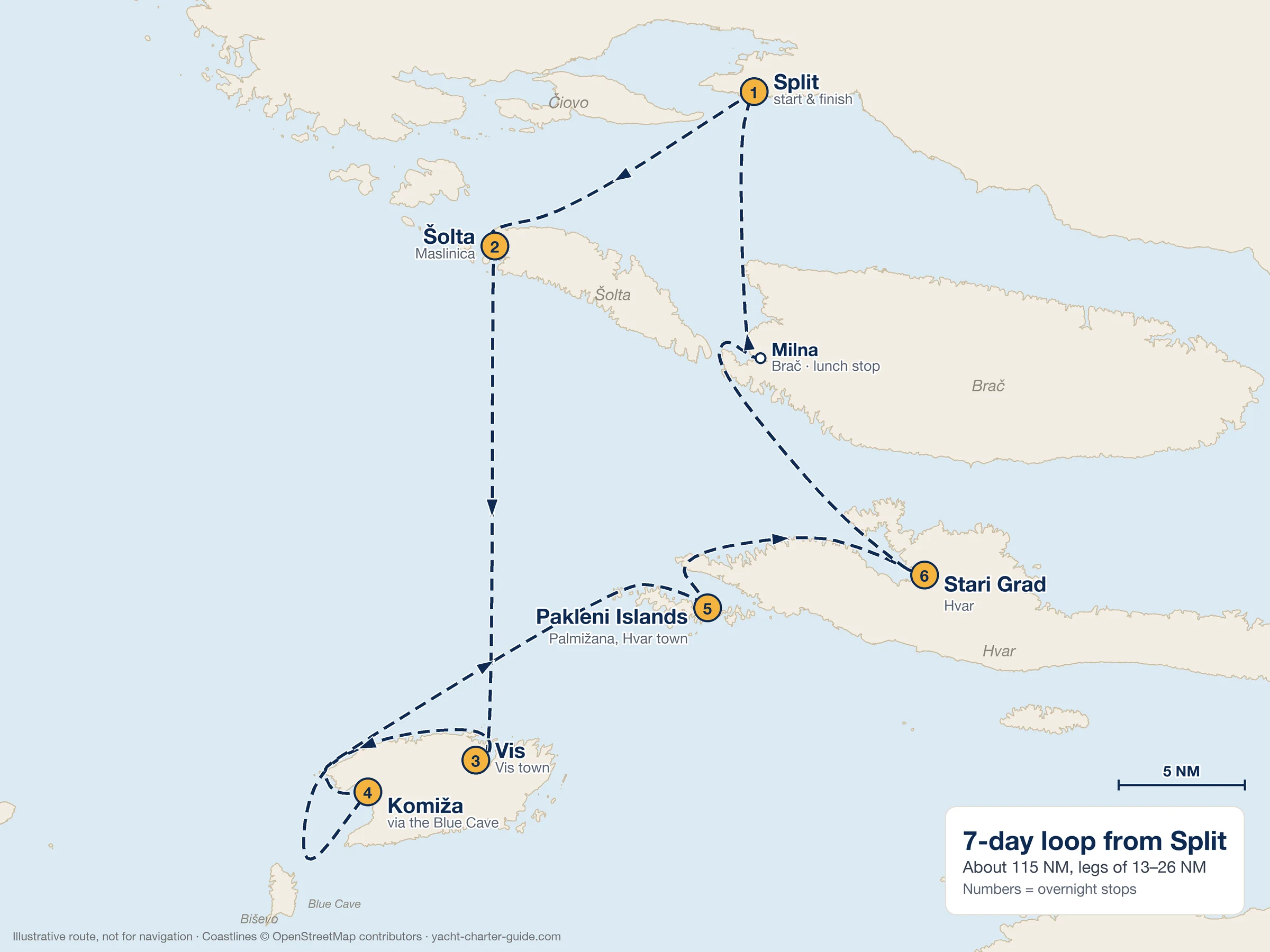
The classic 7-day sailing itinerary from Split is a loop of about 115 nautical miles: Šolta, Vis, the Blue Cave and Komiža, the Pakleni Islands off Hvar, Stari Grad, then back via Brač. Daily legs run from 13 to 26 NM, or roughly three to five and a half hours at an average of 5 knots. It mixes one open-water crossing to Vis with sheltered island hops, so it suits crews with some experience in June or September. Below you get the route day by day, where to moor, what changes with the wind, and a one-way version to Dubrovnik.
Key takeaways
- About 115 NM over 7 nights: Split, Šolta, Vis, Komiža, the Pakleni Islands, Stari Grad and back via Brač.
- The only open-water leg is Šolta to Vis (about 21 NM): sail it in the morning and check the forecast.
- Private boats cannot enter the Blue Cave: you moor at Mezuporat on Biševo and take an official cave boat.
- Book marina nights in July and August, especially Palmižana and Milna.
- Going one way? Split to Dubrovnik is about 120 NM via Hvar, Korčula, Lastovo, Mljet and Šipan.
The route at a glance
Distances below are measured along a realistic sailing line around the islands, not as the crow flies. Times assume an average of 5 knots, sailing or motoring.
| Day | Leg | Distance | Time | Overnight |
|---|---|---|---|---|
| Saturday | Check-in in Split | Marina | ||
| Sunday | Split to Šolta (Maslinica) | 13 NM | about 3 h | Marina, buoys or bay |
| Monday | Šolta to Vis town | 21 NM | about 4–4.5 h | Town quay or buoys |
| Tuesday | Vis to the Blue Cave, then Komiža | 19 NM | about 4 h + cave visit | Town quay or anchor |
| Wednesday | Komiža to the Pakleni Islands | 22 NM | about 4.5 h | ACI Palmižana or buoys |
| Thursday | Pakleni Islands to Stari Grad | 13 NM | about 3 h | Town quay |
| Friday | Stari Grad to Split, lunch in Milna | 26 NM | about 5–5.5 h | Back at base |
| Total | about 115 NM |
Most Croatian charters run Saturday to Saturday, with the boat back in the base marina on Friday evening. That is why the last day is the longest: plan an early start from Stari Grad.
Day by day
Saturday: check-in in Split
Most charter fleets sit in ACI Marina Split or in Kaštela and Trogir, close to Split airport. Check-in is usually in the afternoon. Use the evening for the old town, built inside Diocletian’s Palace, a UNESCO World Heritage site. Getting from the airport with luggage and provisions is easier by pre-booked transfer: you can book an airport transfer to Split marina at a fixed price.
Sunday: Split to Šolta (13 NM)
A short first leg to settle the crew. Head west past Čiovo to Maslinica, on the west tip of Šolta. It has a small marina and quiet bays nearby, where restaurants often lay moorings for their guests. Nečujam, on the north coast, is a sheltered alternative if the wind is from the south.
Monday: Šolta to Vis (21 NM)
This is the only real open-water crossing of the week, with no shelter for most of the leg. Leave early: the maestral, a north-westerly thermal breeze, usually builds around midday and gives a good reach to Vis. If the jugo or the bura is forecast, swap the order and keep Vis for later in the week, or skip it. Vis town sits in a deep bay on the north coast. The island was closed to foreign visitors until 1989 as a military base, which is part of why it still feels quieter than Hvar.
Tuesday: the Blue Cave and Komiža (19 NM)
Round the north of Vis to Biševo for the Blue Cave. Private boats cannot enter: you moor or anchor at Mezuporat, take a numbered ticket and board one of the small official cave boats. The light is best between about 10 am and 2 pm, says the Komiža tourist board, and the entrance is only 1.5 m high, so a swell can make the visit impossible. Arrive early in July and August, then cross back to Komiža (about 5 NM) for the night, a fishing town on the west coast of Vis.
Wednesday: Komiža to the Pakleni Islands (22 NM)
Back round the south of Vis and north-east to the Pakleni Islands, just off Hvar town. ACI Marina Palmižana has 180 berths and opens from April to October; in July and August, taxi boats run to Hvar town, about 2.4 NM away. Hvar town itself is busy and expensive in high season, so many crews stay in the Pakleni and visit by taxi boat.
Thursday: Pakleni Islands to Stari Grad (13 NM)
Round the west tip of Hvar and into the long, sheltered bay of Stari Grad on the north coast. The town is one of the oldest in Croatia, and the farmland behind it, the Stari Grad Plain, is a UNESCO World Heritage site. It is a calm evening after Hvar town. Vrboska and Jelsa, further east, are quieter alternatives.
Friday: Stari Grad to Split via Milna (26 NM)
The longest day, so start early. Cross the Hvar channel to Milna, a deep, sheltered harbour on the west coast of Brač, for lunch and a swim. Then sail the last 11 NM through the channel between Šolta and Brač back to Split. Refuel before entering the marina; most bases want the boat back by early evening.
Wind, weather and plan B
- Sail long legs in the morning. The maestral usually builds after midday and dies at sunset: usually 10–20 knots, pleasant on a reach.
- Respect the bura. It comes down from the mountains in gusts of 30 to 50 knots. When it is forecast, stay in a protected harbour such as Milna or Stari Grad.
- Watch the jugo before Vis. The south-easterly brings swell and rain; it makes the Vis crossing and the Blue Cave uncomfortable.
- Check the official forecast from the DHMZ every morning, and keep one spare day in your head.
If Vis is off the table, a calmer loop works well: Split, Šolta, the Pakleni Islands, Stari Grad or Vrboska, Bol on the south coast of Brač, Milna and back. Legs stay between about 10 and 23 NM, and you are never far from shelter. More on seasons in our guide to the best time to sail in Croatia.
Where to moor and what it costs
Central Dalmatia mixes marinas, town quays, buoy fields and free anchorages. A 39 ft yacht pays about €160 a night at ACI Split in peak season 2026, and a catamaran about €320. Town quays and buoy fields cost less, and anchoring is free. A typical week mixes three or four paid nights with nights on buoys or at anchor. In July and August, book Palmižana and Milna in advance or arrive by early afternoon.
Sailing a catamaran? Our Croatia catamaran charter guide covers 2027 prices, the catamaran surcharge in marinas and a 7-day Kornati route from Biograd.
One way: Split to Dubrovnik in 7 days
Many companies offer one-way charters between Split and Dubrovnik for an extra fee. The southern islands are wilder and less crowded. This version covers about 120 NM:
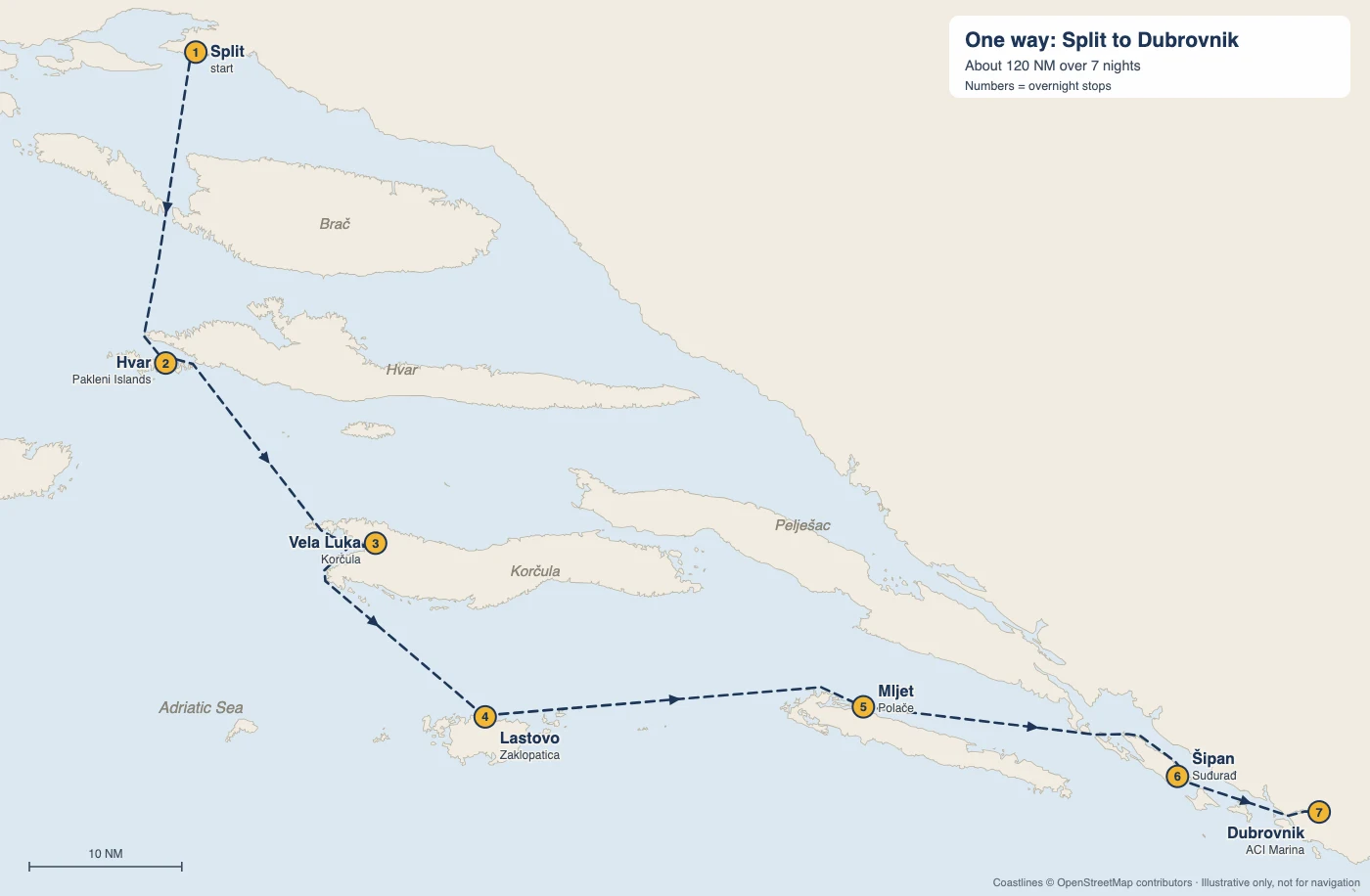
| Day | Leg | Distance |
|---|---|---|
| Sunday | Split to the Pakleni Islands (Hvar) | 22 NM |
| Monday | Pakleni Islands to Vela Luka (Korčula) | about 19 NM |
| Tuesday | Vela Luka to Lastovo | 19 NM |
| Wednesday | Lastovo to Polače (Mljet) | about 25 NM |
| Thursday | Polače to Šipan | 23 NM |
| Friday | Šipan to Dubrovnik | about 10 NM |
Lastovo and Mljet are the highlights: Lastovo is a nature park with very little traffic, and Polače lies inside Mljet National Park, which charges an entrance fee. The Lastovo to Mljet leg is the longest and most exposed, so plan it for the calmest day. Bases in Dubrovnik are usually up the Rijeka Dubrovačka inlet at Komolac, a few miles beyond the old town.
Before you go
- Licence: for bareboat, Croatia asks for a recognised skipper licence and a VHF radio certificate. No licence? Hire a skipper.
- Best months: June and September for this route: warm water, steady maestral and room in the harbours.
- Book early for July and August, both the boat and the busiest marinas.
- Checklist: our yacht charter checklist covers documents, the deposit and the boat check-in.
Related: starting from the south instead? See the 7-day sailing itinerary from Dubrovnik. For the bora, jugo and emergency numbers, read Is it safe to sail in Croatia?, and for a full budget the Croatia yacht charter cost guide.
Recommended reading
- Adriatic Pilot (Imray, Trevor and Dinah Thompson, 9th edition, 2026): harbours, marinas and anchorages along the whole Croatian coast.
Links go to Amazon. As an Amazon Associate I earn from qualifying purchases.
Have two weeks? Our 2-week Croatia sailing itinerary continues this route south to Dubrovnik.
Starting from Split? You can compare the boats based in Split and Kaštela on SkipperCity, a Croatian charter specialist.
Frequently asked questions
How far can you sail in a week from Split?
About 100 to 130 nautical miles is comfortable for a holiday crew: 3 to 5 hours of sailing a day. The loop in this guide covers about 115 NM; the one-way route to Dubrovnik about 120 NM.
Is Vis worth the crossing from Split?
Yes, if the weather allows. The 21 NM crossing from Šolta is the only open-water leg of the week, but Vis and the Blue Cave are quieter and more authentic than Hvar. Sail it in the morning and skip it if the jugo or the bura is forecast.
Can you take your own boat into the Blue Cave?
No. Private boats moor or anchor at Mezuporat on Biševo, and visitors enter the cave on small official boats with a numbered ticket. Go between about 10 am and 2 pm for the best light.
Do you need to book marinas in Croatia?
In July and August, yes for the popular ones such as Palmižana and Milna, or arrive by early afternoon. In June and September there is usually space without booking.
Can you sail one way from Split to Dubrovnik?
Yes. Many charter companies offer one-way trips for an extra fee. The route via Hvar, Korčula, Lastovo, Mljet and Šipan covers about 120 NM in a week.