Catamaran Charter in Croatia: 2027 Prices, Bases and Best Routes
A bareboat catamaran charter in Croatia costs roughly €1,750–€3,000 a week in low season and €7,000–€9,000 in July and August for a 40–42 ft boat. A newer 46-footer runs from about €6,300 to €15,000. On top, budget for a mandatory charter pack, marina fees (catamarans pay 50–60% more than monohulls), fuel and tourist tax, or €180–€270 a day for a skipper. Start from Split or Trogir for Hvar and Vis, or from Biograd and Murter for the Kornati.
Key takeaways
- A 40–42 ft catamaran costs about €1,750–€3,000 a week in low season and €7,000–€9,000 in peak season.
- Marinas charge catamarans 50–60% more than monohulls, so mix marina nights with anchorages and buoys.
- Bareboat skippers need a recognised licence and a VHF radio certificate in Croatia.
- Split and Trogir have the biggest choice of boats; Biograd and Murter are the gateway to the Kornati.
- Book July and August catamarans by January or February: the best boats go first.
This guide uses real 2027 price lists from charter companies, marina and park fees, and official sources, so you can work out the full cost of the week, not just the headline price. For the wider picture, see our Croatia yacht charter guide.
How much does a catamaran charter in Croatia cost in 2027?
Prices follow the season closely. The table below shows weekly bareboat fees from three 2027 price lists: a 2025 Lagoon 40 in Trogir, a Lagoon 42 in Split and a 2023 Lagoon 46 in Split. Older boats cost less, and the newest or best-equipped ones cost more.
| 2027, per week | Low season (to mid-April, from late October) | May and early June | Mid-June to early July | Mid-July to late August | September |
|---|---|---|---|---|---|
| Lagoon 40 (Trogir) | €1,750 | €2,650–€5,145 | €5,665–€7,730 | €8,150–€9,010 | €6,240–€6,630 |
| Lagoon 42 (Split) | €2,500 | €3,000–€4,250 | €5,000–€7,000 | €7,000–€7,500 | €5,000–€5,500 |
| Lagoon 46 (Split) | €6,300 | €7,425–€9,350 | €11,500 | €14,900 | €10,990 |
The jump between early June and mid-July is the biggest saving you can make: on the Lagoon 40, the first week of June costs about 40% less than the peak weeks. Late June and early September give you summer weather for roughly 15–25% less than August.
The extra costs most listings leave out
- Charter pack: mandatory on most boats. Expect €355–€650 a week, covering final cleaning, bed linen, towels, the dinghy outboard, gas and often Wi-Fi and the cruising permit. The three boats above charge €355, €650 and €550.
- Security deposit: €3,000–€4,000 on these catamarans, usually as a card pre-authorisation. Many bases sell deposit insurance to reduce it.
- Marinas: a 39 ft monohull pays about €160 a night at ACI Split in peak season 2026, and a catamaran about €320; most marinas charge catamarans 50–60% more than a monohull because of their beam. Some marinas charge up to double (YACHT magazine). Budget €200–€300 a night for a 40–46 ft cat in central Dalmatia.
- National parks: the Kornati ticket for an 11–18 m boat costs €95 in high season if you buy it online in advance, €50 in low season, and more on the spot. Telašćica, Mljet and Krka have their own fees.
- Tourist tax: payable for everyone who sleeps aboard (Croatian National Tourist Board), about €1 to €2 per person per day. Your charter company tells you how it is collected.
- Fuel: two engines instead of one. Under sail a catamaran burns little, but motoring in light wind adds up.
- Skipper: €200–€250 a day on these three boats, plus food, and he or she uses one of the cabins.
A real budget: Lagoon 42 for eight people in July
| Item | Cost |
|---|---|
| Charter fee, Lagoon 42, Split, mid-July 2027 | €7,000 |
| Charter pack | €650 |
| Skipper, 7 days at €220 | €1,540 |
| Marinas, 3 nights at about €250 | €750 |
| Buoys and anchorages, 4 nights | €0–€400 |
| Fuel (estimate) | €250–€400 |
| Kornati ticket (if you go) | €95 |
| Tourist tax, 8 people, 7 nights | about €75 |
| Total for the week | about €10,300–€11,000 |
| Per person | about €1,300–€1,375 |
Without a skipper, the same week comes to about €9,000, or €1,100–€1,200 per person. Food and drinks come on top. Our yacht charter checklist covers the deposit, the crew list and what to check at handover.
Bareboat, skippered or crewed catamaran?
| Format | Licence needed | Typical extra cost | Best for |
|---|---|---|---|
| Bareboat | Yes: licence plus VHF certificate | None | Experienced crews who want full freedom |
| Skippered | No | €180–€270 a day plus food | Families and groups without a licence |
| Crewed (skipper + host or cook) | No | From about €8,700 a week, plus APA | Groups who want a holiday, not a job |
For bareboat, Croatia asks for two documents: a recognised skipper licence and a VHF radio operator certificate. An ICC, RYA Day Skipper or higher, or a national equivalent usually works for the licence; the SRC covers the radio. Crewed catamarans are a different market: on Boatbookings, weekly prices for Croatia range from about €8,700 for a Lagoon 51 in low season to €65,000 for a Lagoon 77 in August. On a crewed boat, an advance provisioning allowance (APA), usually 25–35% of the fee, covers food, fuel and marinas.
Where to start: the best catamaran bases in Croatia
Croatia has 86 marinas and almost 19,000 moorings (2025), and the 12 Knots booking site lists more than 1,300 catamarans for charter. The base you pick decides the islands you can reach in a week.
| Base | Airport | Best for |
|---|---|---|
| Split, Kaštela, Trogir | Split (SPU), 10–30 min | Šolta, Brač, Hvar, Vis. The widest choice of catamarans; Trogir is often among the cheapest starts. |
| Biograd, Murter, Šibenik, Sukošan | Zadar (ZAD) or Split | Kornati, Telašćica, Krka. Short hops between many islands, often calmer water. |
| Dubrovnik | Dubrovnik (DBV) | Elaphite islands, Mljet, Korčula. Smaller fleet; good for one-way trips from Split. |
| Pula | Pula (PUY) | Istria and the Kvarner islands. Fewer catamarans and more bura in the north. |
If this is your first catamaran week, start in central Dalmatia: distances are short and marinas plentiful. For a quieter week with more nights at anchor, the Kornati side is hard to beat. Our sample 7-day route from Split covers the first option; the route below covers the second.
Which catamaran should you choose?
| Size | Typical charter models | Cabins | Guests |
|---|---|---|---|
| 38–40 ft | Lagoon 40, Bali 4.0, Fountaine Pajot Lucia 40 | 3–4 | up to 8–10 |
| 42–43 ft | Lagoon 42, Bali 4.2, Fountaine Pajot Astrea 42 | 4 (+2 bunks) | up to 8–10 |
| 45–47 ft | Lagoon 46, Bali 4.6, Nautitech 46, Fountaine Pajot Saona 47 | 4–6 | up to 10–12 |
| 50 ft and over | Lagoon 50 and 51, Bali 5.4 | 5–6 | up to 10–12 |
Four couples fit comfortably on a 42-footer; with children or a skipper, go one size up. Bali models have an opening front door to a forward lounge; Lagoons are the most common in Croatian fleets and the easiest to compare like for like. Check the build year: a boat from the last three years usually costs more but has a watermaker, solar panels or a generator. If you are still deciding, read our catamaran vs monohull comparison.
When to go and what the wind does
June and September are the best months for a catamaran: warm sea, lighter crowds and prices well below peak. In summer the maestral, a thermal north-westerly, builds around midday and fades in the evening: ideal for a catamaran on a beam reach. The bura is the wind to respect. It drops from the mountains in gusts of 30–50 knots, mostly outside summer, and a high-sided catamaran feels it more than a monohull. Check the official DHMZ forecast every morning. Month by month details are in our guide to the best time to sail in Croatia.
Sample 7-day catamaran route: Biograd and the Kornati
This loop plays to a catamaran’s strengths: short legs, shallow sandy bays and a lot of anchoring. It starts and ends in Biograd, and covers about 70 nautical miles.
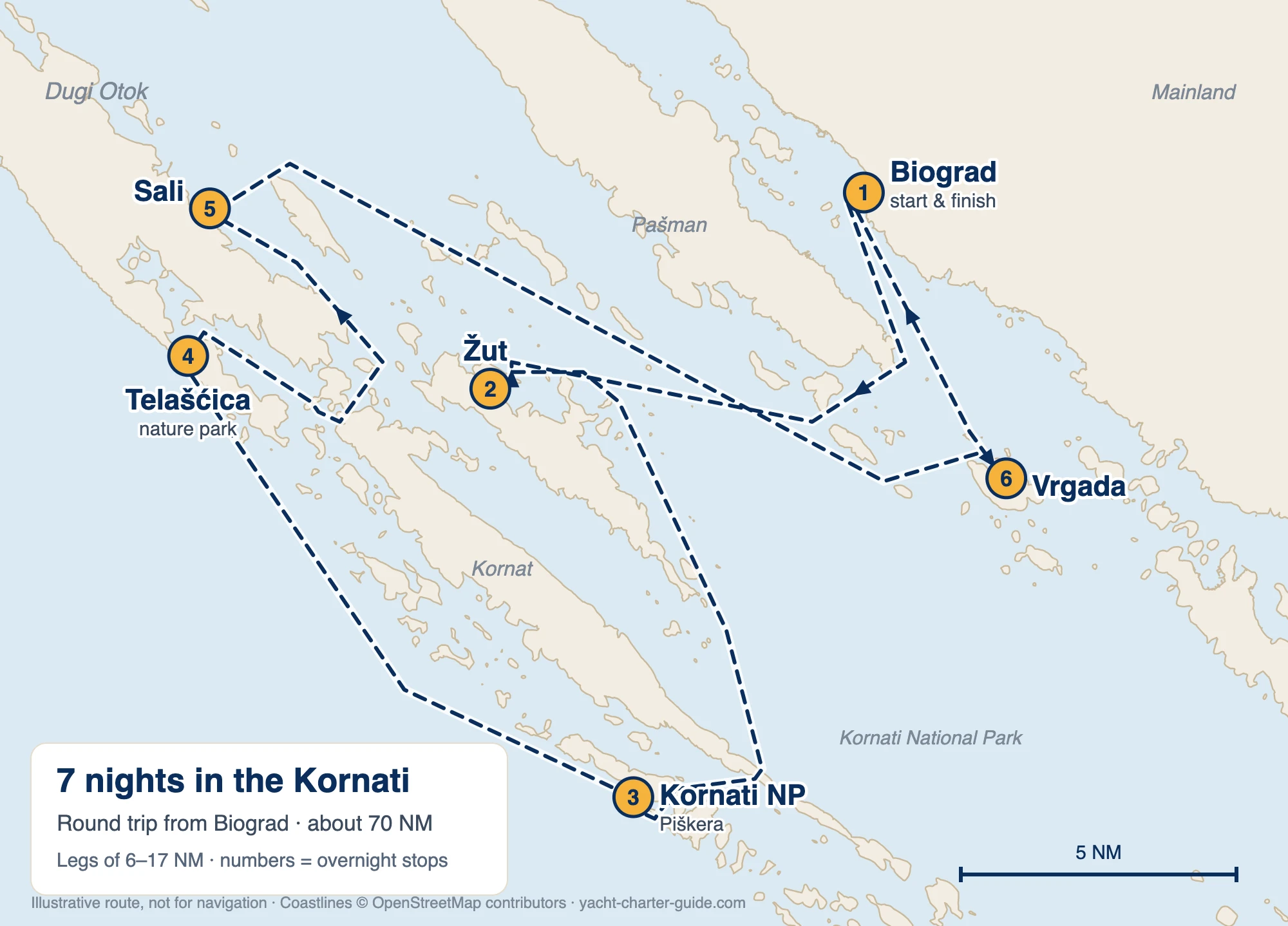
- Saturday: check-in at Biograd, provisioning, first night in the marina.
- Biograd to Žut (about 12 NM). Round the south tip of Pašman to Žut, with a quiet marina and bays.
- Žut to the Kornati National Park (about 13 NM). Buy the park ticket online first. Overnight at Piškera, inside the park.
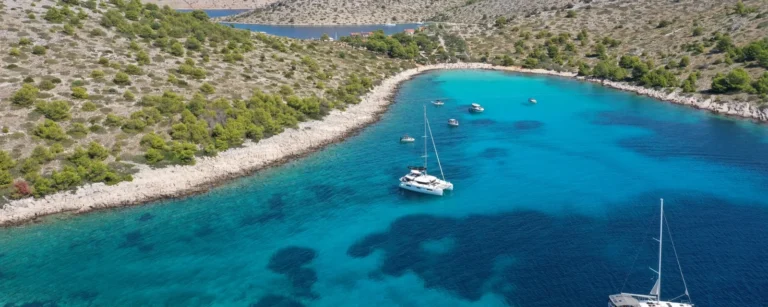
- Piškera to Telašćica (about 12 NM). Along the outer Kornati to Telašćica nature park: the salt lake and the cliffs of Dugi Otok.
- Telašćica to Sali (about 9 NM). A short day to a fishing village with a town quay and tavernas.
- Sali to Vrgada (about 17 NM). The longest leg, to a small island with shallow, sandy bays.
- Vrgada to Biograd (about 6 NM). A short morning sail, refuel, and back by Friday evening.
Starting from Split instead? Our 7-day sailing itinerary from Split covers Šolta, Vis, the Blue Cave, Hvar and Brač, with the distance of every leg.
Seven tips for a catamaran charter in Croatia
- Book early. For July and August, book by January or February; for June and September, three to four months ahead is usually enough.
- Compare the charter pack, not just the fee. €300 of difference in the pack can cancel out a cheaper headline price.
- Mix marinas and anchorages. With catamaran surcharges, three marina nights a week keep the budget under control.
- Use your draft. At 1.2–1.5 m, a catamaran can anchor closer to the beach than most monohulls; still use the bridle and check the holding.
- Arrive early in high season. Town quays and buoy fields fill by mid-afternoon, and a catamaran needs a wider space.
- Plan around the bura. When it is forecast, stay in a protected harbour and avoid anchoring at the foot of mountains.
- Buy park tickets online. On-site prices at Kornati are higher than the advance price.
Sailing in Greece instead? Compare with our catamaran charter guide for Greece, where the meltemi changes the choice of region.
Budgeting? Our Croatia yacht charter cost guide compares monohull, catamaran and crewed prices for 2027, with berths, park fees and two full budgets.
Recommended reading
- Adriatic Pilot (Imray, Trevor and Dinah Thompson, 9th edition, 2026): harbours, marinas and anchorages along the whole Croatian coast.
Links go to Amazon. As an Amazon Associate I earn from qualifying purchases.
You can also compare catamarans available across Croatia on SkipperCity, a Croatian charter specialist.
Frequently asked questions
How much does it cost to charter a catamaran in Croatia for a week?
A 40–42 ft bareboat catamaran costs about €1,750–€3,000 a week in low season, €5,000–€7,000 from mid-June to early July and €7,000–€9,000 in late July and August. Add a charter pack (€355–€650), marinas, fuel and tourist tax.
Do I need a licence to charter a catamaran in Croatia?
Only for bareboat. The skipper needs a recognised boating licence and a VHF radio operator certificate. Skippered and crewed charters need no licence.
Are marinas more expensive for catamarans in Croatia?
Yes. Most marinas charge catamarans 50–60% more than a monohull of the same length because of the extra beam, and a few charge up to double.
Where is the best place to start a catamaran charter in Croatia?
Split or Trogir for Hvar, Vis and Brač, with the largest fleets. Biograd or Murter for the Kornati and Telašćica, with shorter legs and more anchorages.
How many people fit on a charter catamaran?
A 40–42 ft catamaran usually sleeps 8 to 10 in four double cabins plus bunks. A 45–46 ft model sleeps 10 to 12.
Can I sail a catamaran from Split to Dubrovnik one way?
Yes, many companies offer one-way charters between Split and Dubrovnik, usually for an extra fee. Ask before you compare quotes.