Sailing Croatia vs Greece: Which Is Better for Your Charter?
Choose Croatia if you want short, sheltered hops between green islands, gentle summer winds, walled medieval towns and a dense network of marinas. Choose Greece if you want more variety, warmer water, free anchoring and town quays, and, in the Cyclades, real wind. For a first charter, Croatia’s Central Dalmatia and Greece’s Ionian or Saronic Gulf are the easiest; the Cyclades in July and August are for experienced crews. This comparison goes point by point, with numbers, to help you decide.
Key takeaways
- Wind: Croatia’s summer maestral is mostly Force 2 to 4; the Cyclades meltemi is often Force 5 and can reach 40 knots in July and August.
- Distances: our 7-day Split loop covers about 115 NM; our 7-day Cyclades loop about 205 NM.
- Mooring: Croatia relies more on paid marinas and buoys; Greece has more free anchorages and cheap town quays.
- Licences: Greece also requires a second experienced crew member; Croatia requires a VHF radio certificate.
- Both use the euro and have similar charter prices; Greece’s season runs a little longer into autumn.
Croatia vs Greece at a glance
| Croatia | Greece | |
|---|---|---|
| Summer wind | Maestral, NW, Force 2 to 4, afternoons | Meltemi in the Aegean, often Force 5, sometimes more; lighter maistro (Force 3 to 5) in the Ionian |
| Main hazard | Sudden bora, jugo swell | Strong meltemi for 2 to 4 days at a time |
| Islands | About 1,246 islands, islets and reefs; about 50 inhabited | About 6,000 islands and islets; 227 inhabited |
| Typical 7-day loop | About 115 NM (Split) | About 205 NM (Cyclades); shorter in the Ionian and Saronic |
| Overnight stops | Marinas, town quays, paid buoys | Town quays, free anchorages, fewer marinas |
| Taxes | Tourist tax, about €1 to €2 per person per day | TEPAI cruising tax, usually included in the charter price |
| Licence | Skipper licence + VHF certificate | Skipper licence + second experienced crew member |
| Best for | Beginners, families, history and food lovers | Variety, beaches, warm water; strong-wind sailing in the Cyclades |
Wind and sailing conditions
This is the biggest difference. In Croatia, the summer maestral is a north-westerly sea breeze that builds in the late morning, typically blows Force 2 to 4 and dies in the evening, so mornings are calm and nights quiet. The risks are the bora, a gusty north-easterly that can arrive suddenly, mostly outside summer, and the jugo, a south-easterly that raises a swell in spring and autumn (SeaHelp).
In Greece, it depends on the sea. The meltemi blows across the Aegean from late May to October and is strongest in July and August, especially in the Cyclades. It usually comes in episodes of 2 to 4 days, blowing mainly from morning to evening (Aegean Islands); it is often around Force 5 and can reach 40 knots with short, steep seas (Yachting.com). The Ionian is far gentler, with an afternoon breeze of Force 3 to 5 (Yachting Monthly), which makes it Greece’s equivalent of Central Dalmatia.
Verdict: for relaxed summer sailing, Croatia or the Ionian. For sailors who want real wind, the Cyclades.
Distances between islands
Croatia’s islands run parallel to the coast in long chains, so you are almost always in sheltered water with the next harbour in sight. On our 7-day loop from Split, legs run from 13 to 26 NM and the week totals about 115 NM. In the Cyclades, islands are more spread out across open sea: our 7-day Cyclades itinerary totals about 205 NM with legs of 8 to 38 NM, often with the meltemi on the beam. The Ionian and the Saronic Gulf offer shorter hops closer to the Croatian pattern.
Marinas, moorings and anchoring
Croatia has a very developed marina network: 216 nautical ports in 2025, including 86 marinas and 71 managed anchorages (Croatian Bureau of Statistics), with the ACI chain operating more than 20 of them. The downside is cost: in 2026 a 12 m boat paid €86 to €204 a night in ACI marinas (mySea), and many popular bays now have paid buoy fields.
Greece has fewer full-service marinas outside Athens and a few hubs, but almost every island has a town quay where you moor stern-to, often for free or a few euros, and sandy bays are easier to anchor in. You get a more traditional, self-reliant style of sailing, but busy quays in summer need early arrival and good anchoring skills.
Costs, taxes and licences
- Charter prices: broadly similar. Both countries offer 38 to 46 ft monohulls from roughly €1,800 to €5,500 a week depending on the season. See our Croatia charter cost guide and Greece charter cost guide.
- Running costs: Croatia is usually more expensive on berths, buoys and national park tickets; Greece is cheaper if you use town quays and anchor.
- Taxes: Greece charges a cruising tax called TEPAI on boats over 7 m; on charter boats the operator pays it and usually includes it in the price (AADE). In Croatia, charter guests pay a tourist tax, about €1 to €2 per person per day, at check-in.
- Licences: Croatia accepts the ICC and many national licences, plus a VHF radio certificate. Greece accepts the ICC or RYA Coastal Skipper and above (not RYA Day Skipper) and also requires a second experienced crew member on the crew list (Filovent). Details in our Greece licence guide.
- Currency: both use the euro; Croatia adopted it on 1 January 2023.
Scenery, culture and food
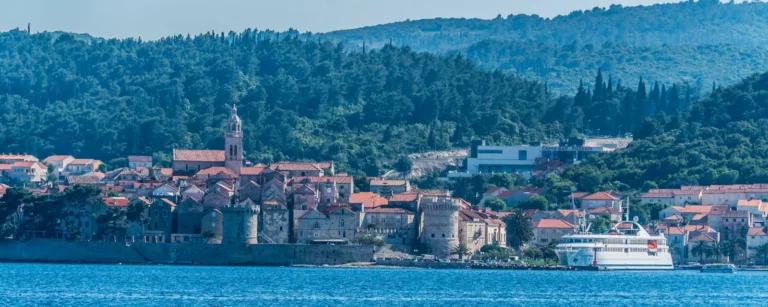
Croatia is green: pine-covered islands, clear water over rock, and stone towns with Venetian architecture such as Korčula, Hvar and Dubrovnik, plus two marine national parks, Kornati and Mljet. Konobas serve grilled fish, peka and local wines. Greece is more varied: the white villages and dry landscapes of the Cyclades, the green Ionian islands, ancient sites, and long sandy beaches. Tavernas are generally cheaper than Croatian konobas.

Recommended reading
- Adriatic Pilot (Imray, Trevor and Dinah Thompson, 9th edition, 2026): harbours, marinas and anchorages along the whole Croatian coast.
- Greek Waters Pilot (Imray, Rod and Lucinda Heikell): the standard pilot book for harbours and anchorages across Greece.
Links go to Amazon. As an Amazon Associate I earn from qualifying purchases.
Season and weather
Both seasons run from about April or May to October, with a peak from July to early September. Greece stays warmer for longer: autumn air temperatures are typically 20 to 24 °C there against 17 to 21 °C in Croatia, and the south-east Aegean reaches about 26 °C at the end of August (Sailing Issues). For month-by-month detail, see the best time to sail in Croatia and the best time to sail in Greece.
Getting there
Croatia’s main charter bases are within 30 minutes of an airport: Split airport sits between Trogir and Split, and ACI Dubrovnik is about 25 km from Dubrovnik airport. In Greece, most Saronic and Cyclades charters start from Athens marinas such as Alimos, 35 to 50 minutes from Athens airport, while Ionian charters use Corfu, Preveza or Lefkada. See our Greek charter bases guide.
So which should you choose?
- First bareboat charter or family with children: Croatia (Split or Trogir), or Greece’s Ionian.
- Experienced crew who want wind: the Cyclades in June or September; July and August if you enjoy Force 6.
- Old towns, food and short days: Croatia.
- Lowest running costs and free anchoring: Greece.
- October sailing: Greece, for warmer air and water.
Still deciding? Start with our Croatia sailing guide and our Greece sailing guide, or compare boats: charters in Croatia and charters in Greece.
Frequently asked questions
Is sailing in Croatia easier than in Greece?
In summer, generally yes: winds are lighter, islands are closer and better sheltered, and marinas are everywhere. Greece’s Ionian is similarly easy; the Cyclades are harder because of the meltemi.
Is Croatia or Greece cheaper for a yacht charter?
Boat prices are similar. Greece is usually cheaper overall because town quays and anchorages are often free, while in Croatia marinas, buoys and park tickets add several hundred euros a week.
Which has better weather for sailing in September?
Both are excellent. Greece is a little warmer and the meltemi weakens; Croatia is quieter, with mild winds and a slightly higher chance of a jugo or bora late in the month.
Do I need a different licence for Greece and Croatia?
An ICC works in both. Croatia also asks for a VHF radio certificate. Greece does not accept RYA Day Skipper and asks for a second experienced crew member.